How to read an academic paper efficiently
Contents
Don't read an academic paper from start to finish like a novel. The most efficient method is non-linear: skim the abstract and conclusion first to get the main argument. Studies show techniques like skimming can double your reading speed, and one study saw test scores on comprehension jump from an average of 46.11 to 78.33 after training. This strategic approach saves time and ensures you understand the core message before getting lost in the details.
How is reading an academic paper different from other texts?
Reading a scientific paper is completely different from reading a novel or a blog post. You shouldn't read it from beginning to end. Its standardized structure (Abstract, Methods, Results, Discussion) is a roadmap designed for strategic, non-linear reading to extract information efficiently and effectively.
The structure of an academic paper is your road map. Unlike a story that unfolds chronologically, a paper lays out its argument in a standardized format: Abstract, Introduction, Methods, Results, and Discussion (often called IMRaD). The best way to read one is to jump between these sections based on what you need to know. Your approach will change depending on your goal. Are you trying to understand a new field, find a specific method, or critique the results? Your purpose dictates your path.
The biggest mistake is treating a paper like a book. Reading it cover-to-cover is a recipe for getting lost in the details before you've even understood the main point.
The table below shows the difference between a passive, linear approach and an active, strategic one.
| Reading Like a Novel (Inefficient) | Reading Strategically (Efficient) |
|---|---|
| Start at page one and read to the end. | Jump between sections based on your goal. |
| Try to understand every word on the first pass. | Get the big picture first, then dive into details. |
| Passively consume the information as presented. | Actively engage with questions in mind. |
| Takes a long time and it's easy to get lost. | Saves time and focuses on what you actually need. |
Think of it as assembling a puzzle. You wouldn't start with a random piece in the middle. You'd look at the box to see the final image, sort the edge pieces, and then build inward. Reading a paper works the same way: get the big picture (Abstract, Conclusion), find the framework (Introduction), and then fill in the specific details (Methods, Results).
What are skimming and scanning, and how do they help?
Skimming and scanning are your two most powerful tools for getting through dense academic texts quickly. Skimming is reading rapidly to get the general idea, while scanning is looking for a specific piece of information. Using them can double your normal reading speed and dramatically improve comprehension. This works.
These aren't just tricks; they are proven methods. In one study, teaching students a skimming technique caused their average post-test scores on finding the main idea to jump from 46.11 to an impressive 78.33. Another study found that an experimental group using skimming and scanning saw their reading comprehension improve by an average of 16.11 points more than a control group.
Let's say you're reviewing a paper on a new drug. You could skim the Abstract and Introduction to quickly understand the research question and its context. Then, you might scan the Methods section specifically for the "dosage" and the Results section for "side effects." You get the information you need without reading every single word.
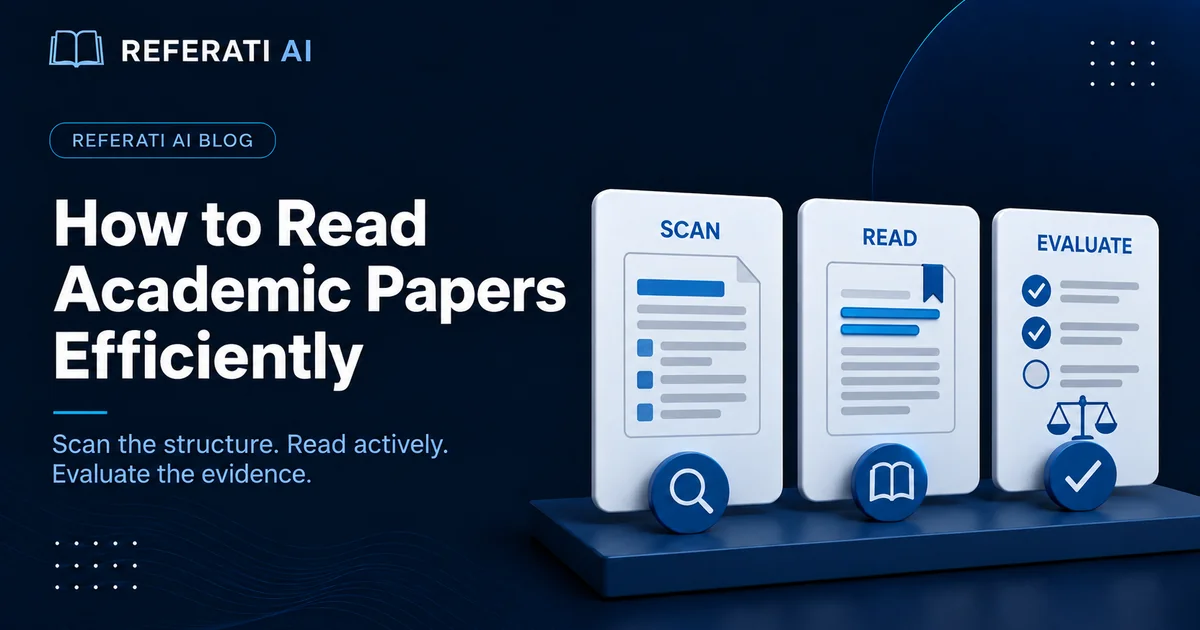
To get started, try this three-pass approach:
- First Pass (The Big Picture - 5 minutes): Read the Title, Abstract, and Conclusion. This tells you what the authors did, why they did it, and what they found. You'll know immediately if the paper is relevant to you.
- Second Pass (The Structure - 10 minutes): Skim the Introduction and the headings for figures and tables. The Introduction provides context, and the figures are often where the most important results are summarized.
- Third Pass (The Details - as needed): Now, read the parts that matter to you carefully. If you need to replicate the experiment, read the Methods. If you're challenging the interpretation, focus on the Results and Discussion.
By following this method, you ensure you never get bogged down in details before understanding the core message.
Why is 'active reading' so important for understanding papers?
Active reading means you engage with the text by constantly asking questions, turning a passive experience into a critical conversation. As cell biologist Tung-Tien Sun put it, active reading is “‘reading with questions in mind.’” This approach is crucial for identifying knowledge gaps and truly understanding the material.
Reading scientific literature isn't just about absorbing facts; it's the key to identifying new research questions and finding gaps in existing knowledge. To do this, you can't just be a bystander. You need to question the author's assumptions, critique their methods, and evaluate their conclusions. Are their claims supported by the data? What are the limitations of their study? What would the next logical experiment be?
Keep a pen and paper (or a digital notepad) handy. Every time you encounter a term you don't know, write it down. You can't fully grasp a paper if you don't understand the vocabulary. Look them up later. This simple habit is crucial for building your expertise in a field.
This process feels like more work upfront, and it is. But the payoff is a much deeper understanding. You'll not only remember more of what you read, but you'll also be better equipped to connect it to your own work and the broader scientific conversation. Without active engagement, you risk simply accepting the authors' interpretation without any critical thought.
Is reading academic papers a skill you can learn?
Yes, absolutely. No one is born knowing how to analyze a research paper. It’s a skill learned through practice and strategy, not a measure of innate intelligence. The key is using a disciplined, multi-pass approach to understand the big picture before diving into the details.
The process requires a disciplined approach to avoid getting lost. Dr. Amina Yonis, an expert on the topic, notes, "By reading research papers this way, you are teaching yourself a disciplined approach and preventing yourself from getting bogged down in the details before you get the big picture." You have to consciously fight the urge to read every word from the start and instead build a mental model of the paper's argument first.
A common trap is relying only on the abstract. This is terrible practice because the abstract omits the nuance, limitations, and specific data needed to form a scientific conclusion. Use the abstract as a guide, not a substitute.
This skill is valuable for everyone, not just professional researchers. Being able to critically read a scientific paper allows you to engage with primary sources directly, whether you're a journalist fact-checking a story or just a curious person wanting to understand a health claim. It takes effort, but with the right strategy, anyone can learn to read and understand a scientific paper. It's about having a system.
Frequently Asked Questions
What are the main principles for reading a paper efficiently?
The key is to read non-linearly. Start with the abstract, introduction, and conclusion to get the main idea. Then, use skimming and scanning to focus on the sections, figures, and tables that are most relevant to your purpose. Don't read it like a novel from start to finish.
What's the difference between reading a scientific article and fiction?
A novel is meant for a linear, immersive experience. A scientific paper is a structured document designed for information retrieval. You read a paper strategically and out of order to extract specific arguments and data, not for narrative flow. The approach is fundamentally different.
Should I read an academic paper in order, from start to finish?
No, this is one of the most common and inefficient mistakes. A linear read-through will likely get you bogged down in the methods and results before you even understand the core hypothesis. A strategic, multi-pass approach is far more effective for comprehension and speed.
What is "active reading" and how will it help me?
Active reading means engaging with the text by asking questions as you go: "What is the main argument here?" "Is this data convincing?" "What are the limitations?" This learned skill turns reading into a critical analysis and dramatically improves your understanding and retention.
How do I figure out my reason for reading a paper?
Before you start, ask yourself what you need from the paper. Are you looking for a specific experimental method? Trying to get a general overview of a new topic? Or critically evaluating its claims to build on them in your own work? Your goal determines your reading strategy.
What role do skimming and scanning play in reading academic texts?
They are essential for efficiency. Skimming gives you the overall gist of the paper quickly, while scanning helps you locate specific facts, figures, or keywords without reading every word. Studies show these techniques can double your reading speed and significantly boost comprehension.
How can I check if a scientific paper is credible?
Check the journal. Is it indexed in a reputable database like PubMed or Web of Science? Look at the authors and their institutional affiliations; reputable universities are a good sign. Be wary of sources funded by organizations with a clear political or commercial agenda.
Try referati.ai: an AI built for academic writing.