How to write an email to your professor
Contents
Sending an email to a professor can be stressful, but it's a skill you'll use constantly in college. The basics are simple: be professional, clear, and concise. Always check your syllabus for an answer before writing. When you do write, use your university email, include the course code in the subject line, and allow 24 to 48 business hours for a response.
Why is professional email communication so important?
A professional email helps build your academic reputation and a positive relationship with your professor. This is crucial for getting help, earning respect, and securing future references. Communicating respectfully shows you take your education seriously, which professors notice and appreciate. It's a basic sign of maturity.
Think of it this way: your emails are part of your professional identity. University is a training ground for the professional world, and professors are not your texting buddies. Communicating with them should be approached with the same respect you'd give a manager. This isn't just about politeness; it's about showing you're a serious student. According to guidance from the University of Southern Mississippi, you must use your official university email. An address like party-animal23@email.com doesn't make a good impression, and your message might go straight to a spam filter.
These small interactions add up over a semester. A student who consistently communicates clearly and professionally is seen as responsible and engaged. When it comes time to ask for a reference for a job or for graduate school, a professor with a folder of your thoughtful emails is far more likely to write a detailed, positive letter than one who only remembers a frantic, typo-filled message sent at 2 a.m.
How should I structure an email to a professor?
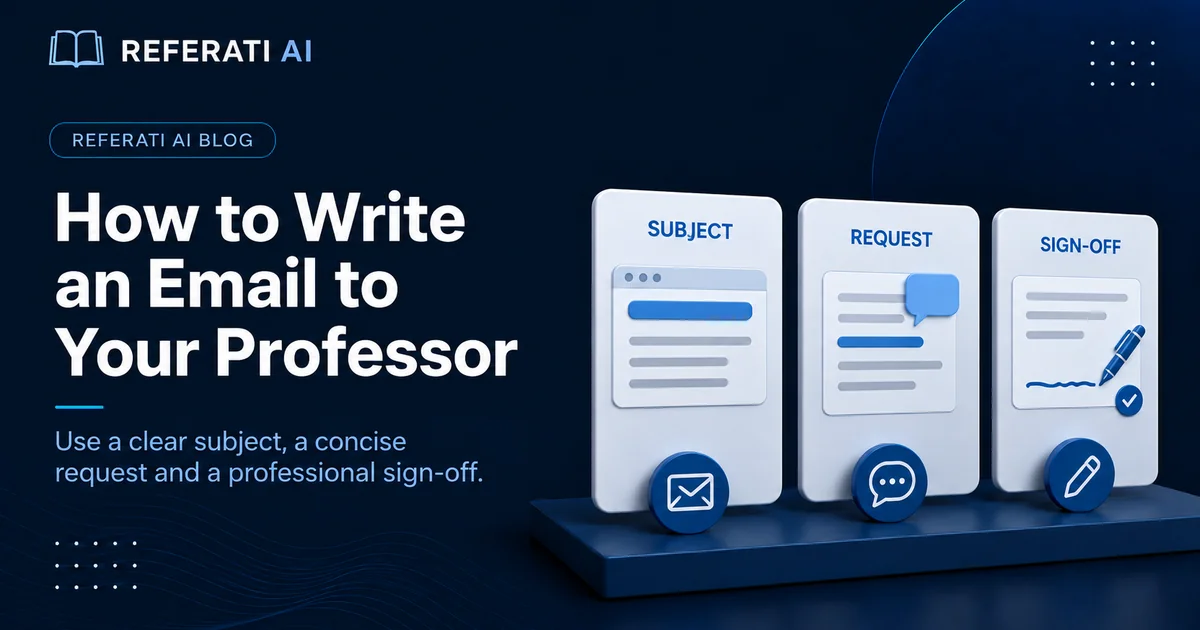
An effective email to a professor has a clear structure. Use a specific subject line with the course code, a formal greeting like "Dear Dr. Smith," a concise body explaining your reason for writing, and a professional closing with your name and student ID. This simple format gets you a better response.
Here is a step-by-step guide to building that email:
- Subject Line: Make it clear and informative. A professor might get hundreds of emails a day, so a vague subject like "Question" is easy to ignore. Include the course code and a brief description of your email's content.
| Bad Subject Line | Good Subject Line |
|---|---|
| URGENT!!!!! | CPSC 121: Question about Midterm Date |
| help | BIOL 200 (Section 4): Request for Office Hours |
| (no subject) | HIST 101: Need Extension on Essay 2 |
-
Salutation: Always begin with a formal greeting. "Dear Professor [Last Name]" or "Dear Dr. [Last Name]" are the standard and safe options. If you aren't sure of their title (Dr., Prof., etc.), using "Professor" is almost always the right choice. Avoid casual openings like "Hey" or their first name.
-
Body: State your purpose politely and directly. In the first sentence, identify yourself and the class you're in. Then, clearly explain why you're writing. Use full sentences, proper grammar, and check your spelling. An email is not a text message.
-
Closing: End with a polite closing like "Best regards," "Sincerely," or "Thank you." Follow this with your full name and student ID number.
Subject: PSYC 310: Question about Research Paper
Dear Dr. Evans,
My name is Jane Doe, and I am a student in your PSYC 310 (Section 002) class this semester.
I am writing to ask for clarification on the citation style for the upcoming research paper. The assignment sheet mentions APA style, but I wanted to confirm if you prefer the 6th or 7th edition.
Thank you for your time.
Best regards,
Jane Doe Student ID: 12345678
What are the most common mistakes to avoid?
The most common mistake by far is asking a question that is already answered in the syllabus. Before you type a single word of your email, check the syllabus, the course outline, and the assignment sheet. Taking this step shows that you respect your professor's time.
Another major pitfall is being too casual. This is a professional relationship, not a friendship. That means no text-speak ("u," "r," "idk"), no emojis, and no overly familiar greetings. One professor shared an email from an Ivy League student that read, "Omg you’re here! Ahh i need to get my shit together now lol. Jk." While maybe funny to a friend, this kind of message comes across as immature and unprofessional.
It's also a mistake to use a professor's first name unless you have been specifically invited to do so. Stick with "Professor [Last Name]" or "Dr. [Last Name]." This small detail shows respect for their position and expertise. Lastly, don't get defensive about feedback. If you get a paper back covered in comments, it is not a personal attack. It's actually a sign that the instructor cares about your development and is investing time to help you improve.
Never demand an immediate response or mark your email as "URGENT" unless it truly is. Professors have many responsibilities. Expecting an answer in an hour is unrealistic and can come across as entitled.
What should I expect for communication beyond the email itself?
The main expectation is patience. Professors are busy, so allow 24 to 48 business hours for a response, as guidelines from Purdue University suggest. Also, frame your needs as polite requests, not demands. An email asking for office hours for a complex issue is often better than a long, detailed message.
Remember that "business hours" is a key phrase here; don't expect a reply at 10 p.m. on a Saturday. If 48 hours pass without a response, it's okay to send a brief, polite follow-up.
People are always more willing to help someone who asks nicely. Instead of writing, "I need an extension," try something like, "I am writing to respectfully request an extension on the upcoming assignment." This acknowledges that they have the right to say no, which makes them more likely to say yes. Your professors are generally on your side. As Katie Higginbotham, an Associate Director of the writing program at Linfield University, says, "We want you to succeed, and most professors are more than willing to help you do that if you'll reach out to us."
If you have a complex issue or a lot of questions, email is not always the best tool. It might be better to email your professor to ask if you can visit during their scheduled office hours to discuss the matter in person.
Frequently Asked Questions
How do I find my professor's correct title for an email?
The best place to look for a professor's title is the course syllabus or the university's faculty directory online. If you can't find it, "Professor [Last Name]" is a safe and respectful default. It's always better to be slightly more formal than too casual.
What info should I include so my professor knows who I am?
Always include your full name, the course name and number, and the section number if applicable (e.g., "Jane Doe, from your ENGL 101, Section 004 class"). Many professors teach hundreds of students, so this context is crucial for them to help you effectively.
How long should I wait for a reply from my professor?
You should give your professor at least 24 to 48 business hours to reply. Remember that weekends and evenings don't count as business hours. Professors have many commitments outside of answering student emails, so instant replies are not the norm.
What's the best kind of subject line for an email to a professor?
A good subject line for a professor email is specific and includes the course code. For example, "PSYC 250: Question about Final Exam" or "CHEM 112: Absence on Oct 26" are much better than "question" or "hi." This helps the professor prioritize your message.
What if I don't get a reply after 48 hours?
It's acceptable to send a polite follow-up if you don't hear back after 48 business hours. You can forward your original message and add a short note like, "Dear Professor [Last Name], I just wanted to follow up on my previous email. Thank you for your time."
Why is using my official university email so important?
Using your university email address (e.g., ending in .edu) ensures your message looks professional and is less likely to be marked as spam by the university's email filters. It also immediately and officially identifies you as a student of the institution.
How should I write an email asking about research opportunities?
Be direct, professional, and show you've done your homework. Mention which of the professor's specific research projects interests you and why. Briefly explain your relevant background, attach your CV or resume, and ask if they would be open to a brief meeting.
Navigating academic writing can be tough, but you don't have to do it alone. For help with structuring essays, refining your thesis, and checking your citations, try referati.ai: an AI built for academic writing.