What the committee actually asks at a thesis defence
Contents5
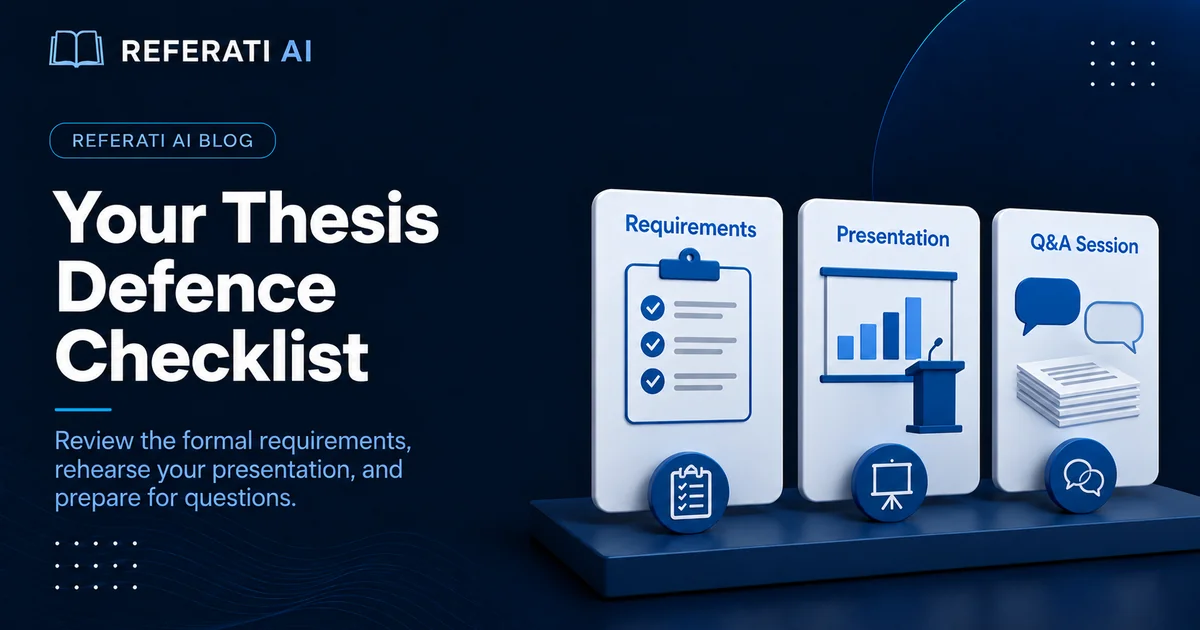
Your thesis defence, or viva, is a structured 1-2 hour conversation about your research, not a pop quiz. Examiners want to confirm you wrote the thesis, understand its contribution, and can think critically about your work. The key to success isn't knowing every detail by heart, but being able to justify your choices and discuss your project's strengths and weaknesses. Prepare a five-minute summary and practice answering common questions about your methodology, findings, and limitations.
What’s the real purpose of a thesis defence?
A thesis defence isn't an interrogation; it's a formal conversation about your research. Think of it as the first time you get to discuss your work with senior colleagues who have actually read it closely. Their goal is to confirm the work is yours, you understand its place in your field, and the thesis is a solid piece of scholarship.
The structure can vary. In some countries, the defence is a public event after the thesis is finalized, so no more changes are made. In others, it's a private meeting where the committee can ask for revisions. As Dr. Priya Singh, founder of Research Made Clear, puts it, your viva is a chance "to explain any unclear sections and present a solid justification for your decisions." They are looking for academic maturity.
The viva serves three main purposes: to confirm you wrote the thesis, to verify your project adds new knowledge, and to ensure the writing is clear and of a high academic standard.
The committee wants to see that you can think critically about what you've created. They expect you to talk about its strengths, its weaknesses, and the choices you made along the way. Perfection isn't the standard. Honest reflection is.
How can I prepare effectively for my defence?
Start your preparation early. A common mistake is to spend weeks perfecting your presentation but almost no time preparing for the question-and-answer part. The most effective strategy is to anticipate the questions you might be asked. Some experts suggest that preparing for about 45 common questions makes the experience feel much less stressful.
A great way to begin is by re-reading your thesis with a critical eye. Pretend you're an examiner. Where are the weak spots? What assumptions did you make? Make notes on these points. Also, prepare a tight, five-minute summary of your thesis covering its main contribution, methods, and key findings. You'll almost certainly be asked to start with a summary like this.
Create a "decision defence" document. For every big choice you made—your topic, methodology, sample, or theories—write one paragraph explaining why you made that choice over the alternatives. This becomes an invaluable study guide.
This process isn't about memorizing your text; it’s about re-engaging with your arguments. You need to be able to explain the "why" behind every decision. If you can, do a mock defence with your supervisor or other students. Practice answering questions out loud. It feels very different from just thinking about the answers.
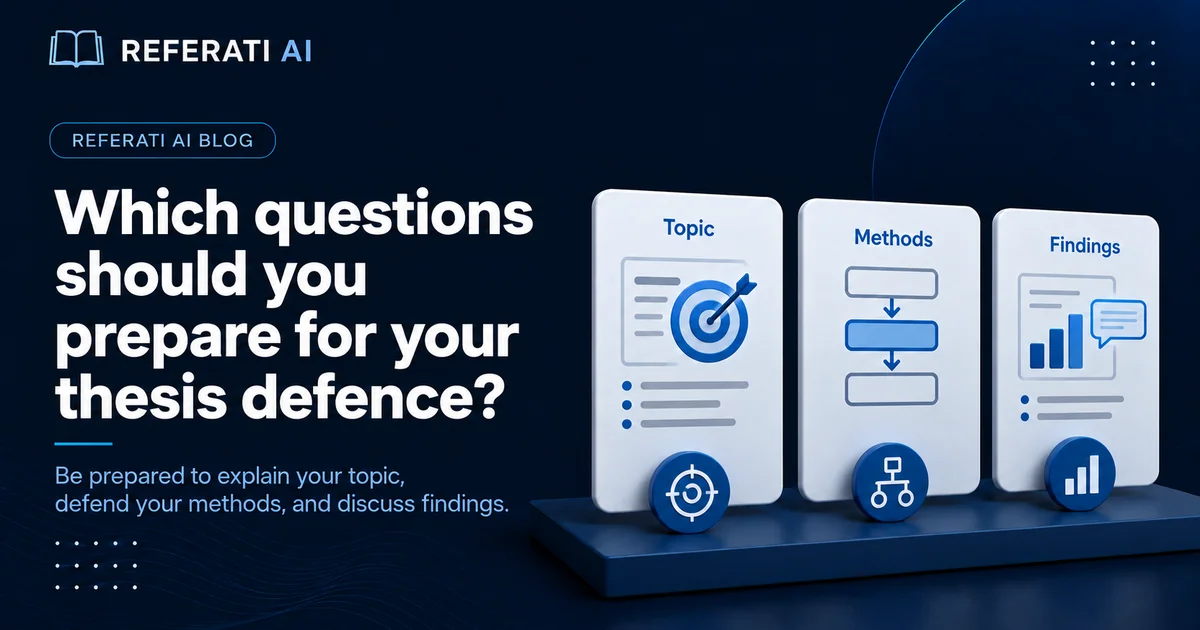
What kinds of questions will the committee ask?
The questions you'll face fall into a few categories. After your short presentation, the committee will ask questions about the presentation itself and your written thesis. Expect broad, open-ended questions at the start, followed by more specific questions as the conversation continues.
They will almost certainly ask about your contribution to the field, your methodology, and the limitations of your study. Don't be surprised by questions that seem incredibly basic, like "Can you summarize your thesis in three sentences?" These check your ability to communicate your core ideas clearly. You can also expect questions about how your work fits with existing research, what you found most surprising, and what you might do differently if you were starting over.
| Myth About the Defence | Reality of the Defence |
|---|---|
| It's a test of memory on every detail. | It's a conversation to test your understanding and critical thinking. |
| You must have a perfect, flawless thesis. | You must be able to identify and discuss your work's limitations. |
| Every question is a trick to trip you up. | Most questions are genuine requests for clarification or justification. |
| You must have an answer for everything instantly. | It's okay to take a moment to think or to admit something is outside your scope. |
Ethical considerations are another major topic. Be ready to discuss how you handled participant consent, data privacy, or any other ethical issues in your research. For a more complete list of potential questions, this list for self-assessment is a great resource that was updated in late 2022.
How do I demonstrate critical thinking and justify my choices?
Your ability to justify your decisions matters more than the decisions themselves. The committee wants to see that your choices were deliberate and well-reasoned, not random. When they ask why you chose a specific methodology or theory, they are testing your critical thinking, not just your knowledge.
The key is to connect your choice back to your research question. Explain how the method you chose was the best tool for the job. Acknowledge that other methods exist, but explain why they were less suitable for your project. Don't just state what you did; explain why you did it. That's the important part.
When asked about choosing qualitative interviews, a strong answer is: "I chose qualitative interviews because my research question was focused on understanding the 'why' behind a phenomenon. They provide a depth of insight into subjective experiences that quantitative methods can't capture, which made them the most appropriate tool."
When discussing limitations, be honest and specific. Admitting limitations shows you have a realistic and mature understanding of the research process. It makes your work stronger, not weaker. Frame these limitations as boundaries that define your claims. For example, a small sample size doesn't invalidate your findings, but it does limit how much you can generalize from them. You should be able to state that clearly.
Frequently Asked Questions
What is the main goal of a thesis defence?
The primary goal is a scholarly conversation where you prove you are the expert on your topic. The committee wants to see that you wrote the work, understand it deeply, and that your research makes a valid contribution to your academic field.
How long does a thesis defence usually last?
Most thesis defences last between one and two hours. The exact length depends on your field, your institution's rules, and how much discussion your work generates. Some can be shorter, and some can be a bit longer.
How should I start preparing for my defence?
Start by re-reading your thesis as if you were an examiner looking for weak points. Prepare a five-minute summary of your project's goals, methods, and findings. The most effective strategy is to anticipate potential questions and practice answering them out loud.
What kinds of questions should I expect?
Expect questions about your research's contribution, methodology, limitations, and ideas for future work. You'll likely get broad opening questions like "Summarize your argument," followed by more specific questions about particular chapters or claims.
What should I do if I don't know the answer to a question?
Don't panic and don't try to fake it. It's perfectly fine to say, "That's an interesting point I haven't considered." You can relate the question to what your research does show or simply acknowledge it as a good idea for future research.
How should I present the limitations of my research?
Present your study's limitations honestly and professionally. Frame them not as mistakes, but as the natural boundaries of the project. For example: "The sample size was limited due to time constraints, which may affect the generalizability of these findings." This shows academic maturity.
Is there a dress code for a thesis defence?
While there may not be a strict university dress code, it's always best to dress professionally. Think business casual or what you would wear to an academic conference. Dressing the part shows respect for the committee and the formal nature of the event.
Organizing your arguments and anticipating questions is a huge part of preparing for your defence. If you're looking for a tool to help structure your thoughts and manage your sources, you might want to try referati.ai, an AI assistant built specifically for academic writing.