How to analyse qualitative data
Contents5
Qualitative data analysis is the art of finding meaning in non-numerical information like interview notes, survey responses, and observations. The goal isn't to count things, but to uncover themes, motivations, and human experiences. Here are the key takeaways:
- What it is: A process for interpreting text, audio, or video to understand the "why" behind people's actions.
- Common Methods: The most widely used approaches are thematic analysis (finding patterns), content analysis (coding words/concepts), and narrative analysis (studying stories).
- The Process: It’s an iterative cycle of collecting data, reading it closely, applying labels ("codes"), and grouping codes into larger themes.
- Data Volume: This work generates a lot of text. A single one-hour interview can easily become a 20-40 page transcript.
- AI's Role: AI tools can now automate transcription and initial coding, saving a lot of time, but human judgment is still needed for deep interpretation.
What is qualitative data analysis?
Qualitative data analysis is the process of systematically studying non-numerical data to find meaningful patterns and insights. Instead of working with spreadsheets, you interpret text, audio, or video to understand the context behind people's actions and opinions. The goal is to build a rich, detailed picture.
If quantitative data tells you that 30% of your customers are unhappy, qualitative data tells you why they're unhappy. As researcher Michael Quinn Patton put it, you're trying to "identify core consistencies and meanings" from large amounts of information. This process is usually inductive, meaning you start with specific observations from your interviews or notes and build broader theories directly from the data itself. You aren't starting with a theory you want to test.
Because of this, context is king. The analysis focuses on understanding the social, cultural, and personal factors that shape what people say and do. You aren't just looking at words on a page; you're exploring the world those words came from. This is why it's so valuable in fields like sociology, market research, and user experience design, where understanding human behavior in its natural setting is the whole point.
What are the main methods for analyzing qualitative data?
The main methods for qualitative data analysis include content analysis, thematic analysis, and narrative analysis. There are about ten common methods in total, and the one you choose depends on your research question and the kind of data you've collected. Each gives you a different lens to see your data through.
Let's look at a couple of popular ones.
Content analysis is used to determine the presence of certain words, themes, or concepts within texts. You can do this by counting word frequency (quantitative) or by interpreting meaning (qualitative). Researchers Hsieh & Shannon defined it as a method for the "subjective interpretation of the content of text data through the systematic classification process of coding and identifying themes or patterns."
A team might use content analysis on patient interviews to find themes about barriers to healthcare. They could code for phrases related to cost, transport, or discrimination to see what stops people from getting care.
Thematic analysis is probably the most flexible and widely used method. Here, your goal is to find, analyze, and report patterns (or "themes"). A theme captures something important about the data that helps answer your research question. A company, for instance, could analyze customer reviews to group feedback into themes like "product quality," "customer service," or "shipping problems."
How does the analysis process actually work?
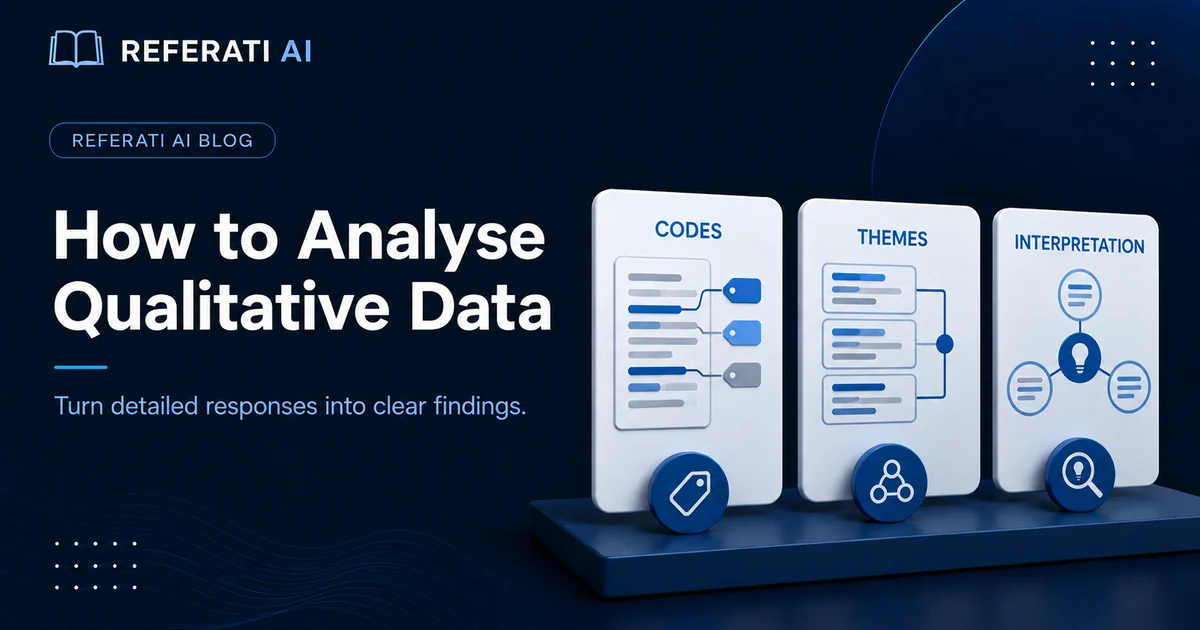
The qualitative analysis process involves gathering raw data (like interview transcripts), reading it repeatedly, applying labels or "codes" to segments of text, and then grouping these codes into broader themes to find patterns. It’s an iterative process, not a straight line, and you often circle back as you develop new ideas.
The journey usually begins with a mountain of raw data. Remember, a single hour-long interview can generate a 20-40 page transcript, so this is no small task. You start by immersing yourself in the data, reading and re-reading to get a feel for what's there. Then comes coding, where you attach labels to chunks of text that seem interesting or relevant.
From these codes, you start building bigger themes or categories. This is where you move from just describing the data to interpreting it. Two main approaches can guide you here:
| Inductive Analysis | Deductive Analysis |
|---|---|
| Starts with the data itself ("bottom-up"). | Starts with a pre-existing theory ("top-down"). |
| You create codes and themes directly from what you observe. | You look for evidence in the data that fits your theory. |
| Best when you know little about the research topic. | Best when you want to test an existing theory. |
This cycle of coding and organizing continues until you reach what researchers call "saturation." That’s the point where looking at new data doesn't give you any new themes.
A common mistake is thinking that the more a theme appears, the more important it is. While frequency can be an indicator, a single, powerfully expressed idea from one person can sometimes be more significant than a theme mentioned superficially by many.
How does AI help (and what are its limits)?
AI helps qualitative data analysis by automating time-consuming tasks like transcription, initial coding, and sentiment detection across huge datasets. For example, AI can sort through thousands of customer reviews in minutes, saving researchers hundreds of hours of manual work. This is a huge change for the field.
Platforms like Zonka Feedback's AI product can sift through support tickets or online reviews, clustering them by topic and flagging whether the sentiment is positive, negative, or neutral. Plus, new AI interviewers can conduct many conversations at once in different languages, a scale human teams could never match. These tools make the first stages of analysis much, much faster.
Despite these advances, AI cannot replace the human analyst. It struggles with ambiguity, cultural context, sarcasm, and ethics. An AI can see that a customer mentioned "price," but it can't understand the desperate tone in their voice or the complex personal history behind their words. The final interpretation still requires human judgment.
AI is best seen as a very fast, very efficient research assistant. It handles the heavy lifting of sorting and initial coding. This frees up the researcher to focus on the more important work: interpretation, theory-building, and understanding the deep human context behind the data.
Frequently Asked Questions
What is qualitative data analysis?
Qualitative data analysis is the method of interpreting non-numerical data like text, audio, or video to understand concepts, opinions, or experiences. It's important because it provides deep, contextual insights into the "why" behind human behavior, which numbers alone can't explain.
How is qualitative different from quantitative analysis?
Qualitative analysis deals with words and meanings to understand experiences in depth. Quantitative analysis uses numbers and statistics to measure things and test hypotheses. Think of it as the difference between having an open-ended conversation and filling out a multiple-choice survey.
What are some common methods for qualitative data analysis?
The most common methods are thematic analysis (identifying patterns), content analysis (examining word and theme frequencies), narrative analysis (studying stories), and grounded theory (building new theories from the data). Your choice of method depends on your research question.
How does AI help with qualitative analysis?
AI speeds up the analysis process by automating tasks like transcribing audio, coding text, identifying themes, and detecting sentiment in large datasets. This automation allows researchers to spend more of their time on interpretation and less on manual organization.
What's the most popular software for this work?
Traditional software includes platforms like NVivo, ATLAS.ti, and MAXQDA, which are built for deep academic analysis. Newer, often AI-powered tools like Dovetail and Zonka Feedback are also popular for more specific uses, like user research and customer feedback analysis.
What are inductive and deductive analysis?
Inductive analysis is a "bottom-up" approach where you start with your data and build themes and theories from scratch. Deductive analysis is "top-down," where you start with an existing theory and look for evidence in your data to support or challenge it.
Try referati.ai: an AI built for academic writing.