How to conduct research interviews for your thesis
Contents5
A solid research interview is the heart of many qualitative theses. For a typical 20,000-word master's thesis, the methodology chapter explaining your interviews will be about 2,500-3,000 words long. Success often comes down to simple techniques, like pausing to let participants elaborate, and using a semi-structured format. Remember, all research with people requires ethical approval from an Institutional Review Board (IRB) before you begin.
What's the standard thesis structure, and what role do interviews play?
A standard master's thesis is around 20,000 words, and the methodology chapter—where you detail your interviews—makes up about 2,500 to 3,000 words. This section justifies your choice of qualitative methods like interviews and explains your data collection process in detail, forming a key part of your argument.
A thesis isn't just one long essay; it's a structured document. While requirements vary by university, a common structure for a 20,000-word master's thesis breaks down something like this:
- Introduction: 1,500-2,000 words
- Literature Review: 5,000-6,000 words
- Methodology: 2,500-3,000 words
- Results/Findings: 3,000-4,000 words
- Discussion: 3,000-4,000 words
- Conclusion: 500-700 words
As you can see, the methodology is a significant piece of the puzzle. This is where you connect theory to practice. Qualitative methods like interviews are chosen when you need to understand the "why" behind human behavior, beliefs, and social settings. A survey might tell you what people think, but a well-conducted interview can reveal how they think and why they feel a certain way. It provides a depth of understanding that numbers alone can't offer.
The word counts are guidelines, not rigid rules. Always check your university's specific requirements. The structure, however, is a reliable map for organizing your research.
How do I conduct an effective research interview?
The key to a great interview is making the participant feel comfortable enough to share openly. One powerful but simple trick is to use silence. When your participant finishes a thought, silently count to three before you speak. Often, they will fill that silence with more valuable information.
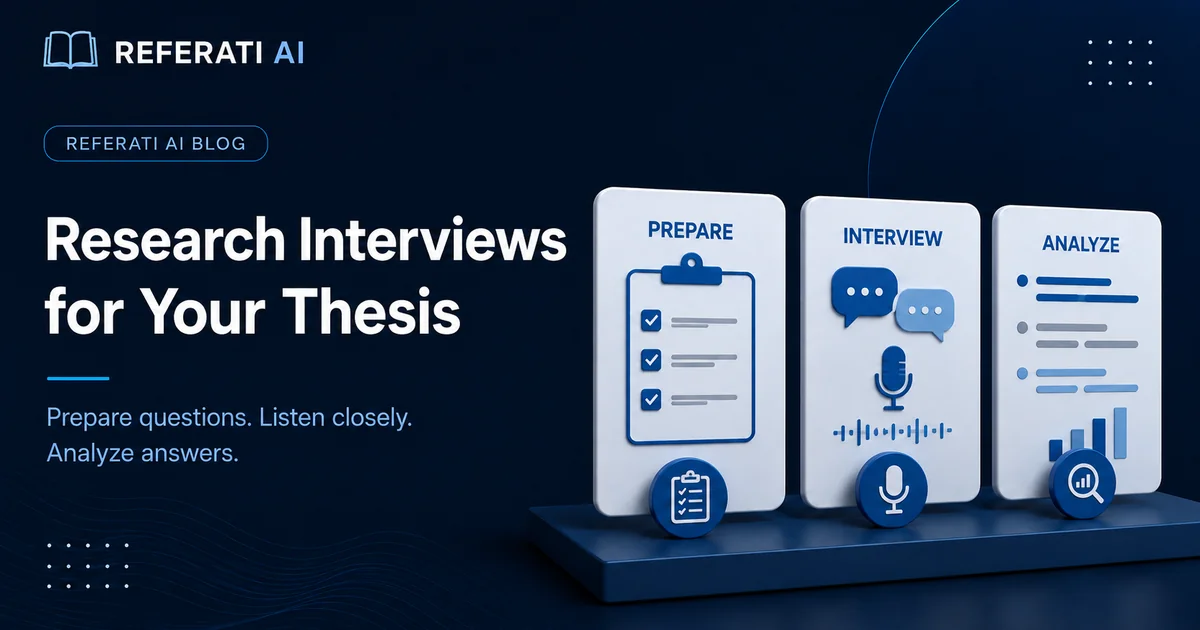
Conducting a good interview is a skill you can learn. It starts with preparation and ends with active listening. Think about the environment: is it quiet, private, and neutral? Your goal is to create a space where the participant feels safe to speak freely.
From there, it's about how you listen. Nikki Anderson-Stanier, founder of the User Research Academy, advises, "Lean in when a participant is talking, nod your head, offer a slight smile, and maintain a (healthy) amount of eye contact. When people feel like you're interested in what they have to say, they'll say more." This isn't about being fake; it's about showing genuine curiosity.
A junior researcher asked a participant, "How did that make you feel?" The person awkwardly replied, "...uh, annoyed?" This was followed by a long, uncomfortable silence. The session was so stilted that the manager had to step in after just 20 minutes. Vague questions get vague answers.
To avoid this, most researchers use semi-structured interviews. You have a guide with key questions, but you also have the freedom to ask follow-up questions and explore interesting tangents that come up.
| Feature | Structured Interviews | Semi-Structured Interviews |
|---|---|---|
| Question Format | Fixed, predetermined questions asked in the same order. | A guide with key questions, but allows for follow-ups and flexibility. |
| Goal | Consistency and easy comparison across participants. | In-depth understanding and exploring unexpected ideas. |
| Best For | Large-scale studies where data needs to be easily quantified. | Qualitative theses where depth and context are the main goals. |
| Flexibility | Low. The researcher must stick to the script. | High. The researcher can deviate to explore interesting answers. |
Finally, treat every interview as a learning experience. As Anderson-Stanier also suggests, you should "[a]lways find time to re-listen to your previous interviews and give yourself feedback on how it could go better in the future." This self-reflection is what turns a good interviewer into a great one.
What ethical considerations should I keep in mind for interviews?
Your top priority during research interviews is protecting your participants. This involves getting their informed consent, guaranteeing their confidentiality, respecting their right to withdraw at any time, and ensuring no harm comes to them. These principles are usually overseen by an Institutional Review Board (IRB) before you start.
Before you can interview a single person, you’ll need to submit your research plan to your university's IRB. This committee's job is to make sure your research is ethical and safe for human subjects. They will review your recruitment materials, consent form, and interview guide. The process might seem bureaucratic, but it's a vital safeguard.
Informed consent is more than just a signature. It means ensuring the participant truly understands what the study is about, what's expected of them, and that they can stop at any point without penalty. You must also be clear about how you will protect their identity. Will you use pseudonyms? Will you remove identifying details from your transcripts? These are promises you must keep.
Never assume you can skip the IRB process. Conducting research with human subjects without approval is a serious academic offense and can invalidate your entire thesis. Start the application early, as it can sometimes take weeks or even months to get approval.
Beyond formal rules, ethics is about building trust. Be transparent about your research goals. Your participants are giving you their time and their stories. Treat them and their data with respect.
What challenges do students face when writing a thesis, and what resources can help?
Students writing a thesis often struggle with managing sources, finding either too much or too little information on their topic. Another common hurdle is securing funding for research expenses. Key resources to overcome these issues include your thesis advisor, university librarians, and internal research grants.
The thesis journey is rarely a straight line. For example, Molly Goldfarb, a Brandeis graduate, described the challenge of finding the right amount of literature. For some parts of her topic, information was overwhelming, while for others, there was almost nothing. She learned to balance this by working closely with her thesis advisor. This highlights the most important resource you have: your supervisor.
Funding can be another challenge. Ben Kacher, another Brandeis grad, secured funding from his university's research fund, which allowed him to use a qualitative data analysis tool called Atlas.ti to code his interview transcripts. Look for similar grants or fellowships at your own university. They exist to support student research.
Don't forget about your university librarians. They are trained experts in finding and evaluating sources. If you're struggling to find literature or feel overwhelmed, schedule a meeting with a subject librarian. They can help you refine your search and point you toward key databases.
You're not alone in this process. Between your advisor, librarians, writing centers, and university research funds, there is a whole network of support available. The trick is to ask for help before you feel completely stuck.
Frequently Asked Questions
What are the goals of research interviews?
Research interviews gather in-depth information about a person's experiences, opinions, and feelings. Unlike surveys, they allow you to explore topics deeply, ask follow-up questions, and understand the context behind someone's answers. The goal is to collect rich, detailed, qualitative data for your thesis.
When should I use qualitative interviews in research?
Use qualitative interviews when you need to understand the "why" or "how" of a phenomenon. They are perfect for exploring complex topics, understanding individual perspectives, and generating new theories. If your research question is exploratory and focuses on meaning and experience, interviews are a great choice.
What should an interview guide look like?
An interview guide for a semi-structured interview lists the key open-ended questions you want to ask, but it isn't a rigid script. It should be organized logically, starting with easy warm-up questions before moving to more substantive topics. Include probes or potential follow-ups to help you dig deeper.
What are the ethical requirements for conducting interviews?
The core ethical requirements include obtaining informed consent, ensuring participant confidentiality and anonymity, minimizing potential harm, and respecting their right to withdraw. All research involving human subjects must typically be approved by your university's Institutional Review Board (IRB) before you begin.
How can I build trust with an interviewee?
Build trust by being transparent and professional. Clearly explain the research purpose and how data will be used. Use active listening skills like nodding and making eye contact, and show genuine interest in their story. A comfortable, non-judgmental environment is the most important factor.
How many interviews are enough for a thesis?
The right number of interviews depends on your research scope and when you reach "saturation"—the point where new interviews no longer yield new insights. For a master's thesis, this is often between 5 and 15 interviews. Quality and depth matter more than sheer quantity.
What do I do with the data after the interview is done?
After an interview, you'll need to transcribe the audio recording into a written text for analysis. The next step is coding—reading the transcript to identify key themes, patterns, and ideas. This process helps you organize the data from your interviews and build your final argument.
As you move from interviews to analysis, you'll be organizing your findings and structuring your arguments. If you find yourself needing support with the academic writing itself, tools like referati.ai are built to help students navigate that process.