How to find and evaluate credible academic sources
Contents5
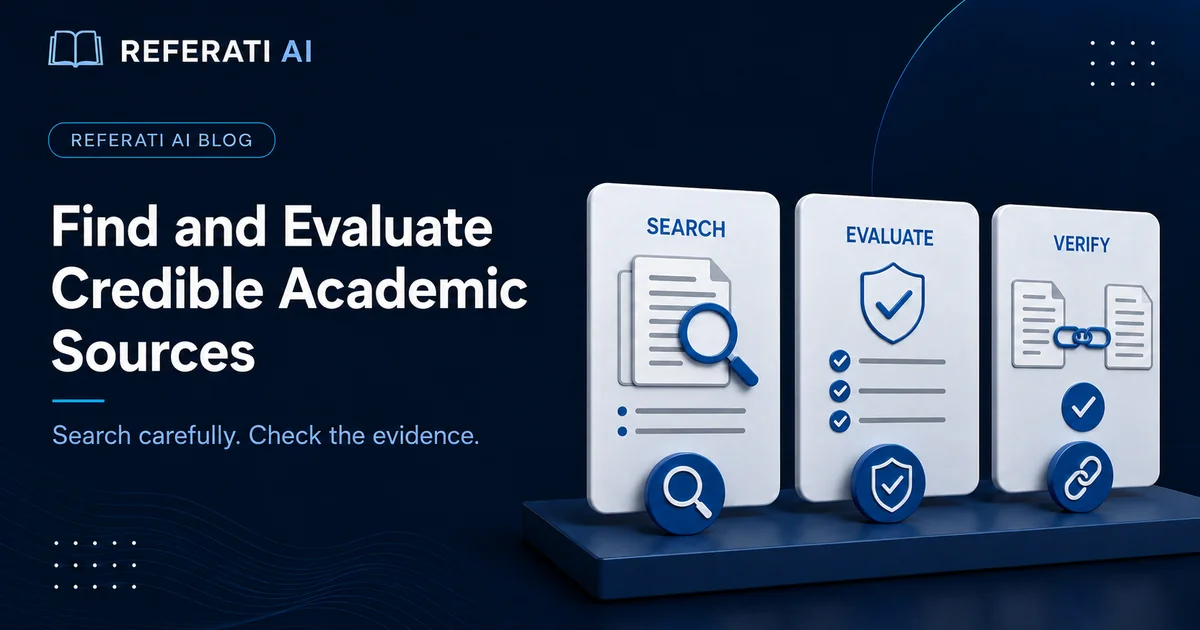
To evaluate academic sources, use frameworks like the CRAAP test for deep analysis and the SIFT method for quick web verification. The CRAAP test, created in 2004, uses a checklist for Currency, Relevance, Authority, Accuracy, and Purpose. For online content, Mike Caulfield's SIFT method (Stop, Investigate, Find better coverage, Trace claims) is more effective. It’s also crucial to spot predatory journals, which accept articles with little review. A 2016 Stanford study showed even students struggle with this, highlighting the need for critical evaluation skills.
What methods can help me evaluate academic sources?
You can use several frameworks, but the two most common are the CRAAP test for deep analysis and the SIFT method for quick web checks. The CRAAP test, developed by librarians in 2004, is a detailed checklist, while SIFT is a faster, more modern strategy for online information.
There isn't one "best" method. The right tool depends on what you're looking at. The CRAAP test is an acronym for Currency, Relevance, Authority, Accuracy, and Purpose. It’s a thorough process that works very well when you're digging into a dense academic article or a book and need to understand its foundations. It forces you to ask detailed questions about the author's credentials, the evidence provided, and the reason the information was created.
For the fast-moving online world, digital literacy expert Mike Caulfield’s SIFT method is often more practical. It's designed for quickly assessing websites, social media posts, and news articles before you invest time in reading them. SIFT stands for:
- Stop: Pause and think. Don't immediately trust or share.
- Investigate the source: Who is behind this? What’s their reputation?
- Find better coverage: Look for other, more trusted sources on the same topic.
- Trace claims to the original context: Find the original source of a quote or statistic.
The big difference is that CRAAP encourages reading "vertically" (deep into one source), while SIFT promotes "lateral reading" (opening new tabs to see what others say).
| CRAAP Test | SIFT Method |
|---|---|
| A detailed checklist for in-depth analysis. | A quick, four-step process for web sources. |
| Best for academic papers and books. | Best for news articles, blogs, and social media. |
| Focuses on evaluating the source itself. | Focuses on verifying information across multiple sources. |
| Asks you to read "vertically" (deep into one source). | Encourages "lateral reading" (opening new tabs to investigate). |
Is evaluating a source an objective process?
No, evaluating a source isn't about giving it a simple "good" or "bad" stamp. It’s a subjective process that depends entirely on your research needs. Your goal isn't to find "perfect" sources, but to find sources that are appropriate for your specific context and question.
Think of it this way: a source that’s useless for one project might be the perfect piece of evidence for another. A personal blog post from a patient describing their experience with a rare disease would be an inappropriate source for a medical paper about the disease's cellular mechanics. That same blog post, however, could be a powerful primary source for a sociology paper about the lived experience of illness. The source itself hasn't changed. Its value has.
This is why your own judgment is so critical. As Ernest Hemingway famously said, a writer needs a "built-in, automatic crap detector." Frameworks like CRAAP and SIFT are just tools to help you calibrate that detector. They guide your judgment, they don't replace it. The Vassar College Library explains this well, noting that source evaluation is "less about making a judgment...and more about determining its appropriateness for your purposes."
Imagine you're writing a paper on the history of computer animation. A 1995 article from Wired magazine detailing the making of Toy Story would be a fantastic primary source. For a paper on modern rendering techniques, however, that same article would be completely outdated and irrelevant.
How can I avoid predatory publications and online misinformation?
Protecting your research starts with recognizing the threats. Predatory journals charge authors fees but provide little to no genuine peer review, polluting the academic landscape. They often have professional-looking websites and journal titles that mimic legitimate publications, making them difficult to spot at first glance.
These operations exploit the "publish or perish" pressure on academics. A major red flag is a promise of rapid publication. Rigorous peer review takes months or even years, so a journal that accepts a paper in a few days is highly suspect. To help authors, the Think. Check. Submit. initiative provides a checklist for identifying trusted journals. It prompts you to ask key questions, such as whether you or your colleagues know the journal and if its peer review process is clearly stated.
A common tactic of predatory journals is to accept articles with little to no editing or review. If you submit a paper and it's accepted within days with no requests for changes, be very suspicious. Reputable journals always have a rigorous review process.
This issue of credibility extends far beyond academic journals. A 2016 report from the Stanford History Education Group found that most students struggled to evaluate online information. "Many assume that because young people are fluent in social media they are equally savvy about what they find there," the report stated. "Our work shows the opposite." The findings were stark: students had trouble telling ads apart from news articles and often couldn't identify the source of the information they were reading. This shows just how important critical evaluation is for everyone.
Is the CRAAP test outdated, and what are the alternatives?
The CRAAP test isn't useless, but its checklist approach can feel slow and limited for today's web. Newer strategies like "lateral reading," which is central to the SIFT method, are often better for quickly verifying online sources and spotting misinformation.
The CRAAP framework, developed in 2004, encourages you to dig deep into a single source. This can be a problem on the modern web, where a biased or completely fake site can be professionally designed to look credible. It can list authors, cite "experts," and link to data that seems real but isn't. If you only stay on that one site to evaluate it, you might be easily fooled.
This is where lateral reading is so effective. Instead of spending a lot of time on a page, you immediately open new browser tabs to see what other trusted sources say about the original site, its author, or its claims. This approach is much faster and more reliable for uncovering bias or a lack of credibility. Recent research from 2024 continues to explore new strategies for digital literacy, showing that this field is constantly adapting to new challenges online.
The next time you land on an unfamiliar website, try this: before reading the article, open a new tab and search for the site's name plus the word "bias" or "review." See what other journalists, fact-checkers, and encyclopedias say about it. This takes less than a minute and can save you from falling for misinformation.
Frequently Asked Questions
What's the most effective method for source evaluation?
There's no single "most effective" method for source evaluation. The CRAAP test is great for a deep dive into an academic article. The SIFT method, with its emphasis on lateral reading, is faster and often better for evaluating websites, news stories, and social media posts. The best approach is having both in your toolkit.
What's the difference between a scholarly source and a popular one?
Scholarly sources, like peer-reviewed journal articles, are written by experts for an academic audience and feature citations. Popular sources, like magazines and news articles, are written by journalists for the general public. They are less formal and don't always cite sources extensively.
What makes a source "primary" or "secondary"?
Primary sources offer direct, firsthand evidence, such as diaries, original research data, or autobiographies. Secondary sources interpret these primary sources. Examples include textbooks, scholarly articles that review existing research, and biographies written by someone other than the subject.
What is "lateral reading," and how does it help evaluate sources?
Lateral reading means leaving the source you're on to see what other websites say about it. Instead of reading "vertically" down the page, you open new tabs to investigate the author and publication. It’s a fast and effective way to spot bias or misinformation on the web.
How can I spot a predatory journal or publisher?
Look for red flags like promises of very fast publication, aggressive email solicitations, and a website with grammatical errors. A lack of a clear peer-review process is also a major warning sign. Use resources like the "Think. Check. Submit." initiative to verify a journal’s legitimacy.
Is the CRAAP test outdated or still relevant?
The CRAAP test is still relevant for a detailed analysis of traditional academic sources like books or journal articles. However, for quick online evaluation, its checklist format can be slow. Newer methods like SIFT are often more practical for navigating the modern web.
Should I trust all information from social media?
No. Social media is filled with opinions, ads, and misinformation. A 2016 Stanford study found that even digitally native students struggle to evaluate online sources. Always use a method like SIFT to trace claims back to their original, more reliable sources before trusting them.
Finding the right sources is a skill, and like any skill, it gets better with practice. When you need help organizing your research and building your arguments, you might want to try referati.ai: an AI built for academic writing.