How to write a research proposal
Contents6
Most research proposals are rejected in less than 60 seconds. Reviewers scan them for clear answers to a few core questions, and if those answers aren't obvious, the proposal gets tossed aside. A strong proposal usually has a 10-15 word title, an abstract under 250 words, and fits within an 8-page limit. To succeed, you have to convince the committee your project is credible, achievable, and important by clearly distinguishing between your research "outputs" (like a paper) and its "impact" (the real-world change it will create).
Why Is a Strong Research Proposal So Important?
Think of your proposal as the blueprint for your entire research project. It’s more than just a document; it’s a persuasive argument for why your idea deserves time, attention, and maybe funding. Most proposals fail fast because reviewers are looking for quick answers, and if your document doesn't provide them, it won't get a second look.
Your proposal is your first, and often only, chance to convince an evaluation committee that your work matters. According to research expert Lennart Nacke, "Most research proposals get rejected in 60 seconds. Reviewers are looking for one thing. Not your clever idea or qualifications. But whether you've clearly answered 5 key questions." If you don't answer them clearly, you're out.
Reviewers are scanning for answers to these five questions:
- What is the problem?
- Why does it matter (who cares)?
- What is your proposed solution?
- How will you carry out that solution?
- What will the impact be if you succeed?
Answering these questions effectively shows your study is credible, achievable, and practical. For some fields, like medicine, you also need to prove your methods are repeatable, as highlighted in guidelines for structuring proposals. It’s not just about having a brilliant idea. It’s about communicating that idea in a structured, logical, and convincing way. You have to prove you’ve thought through every single step.
What Are the Core Sections of a Successful Research Proposal?
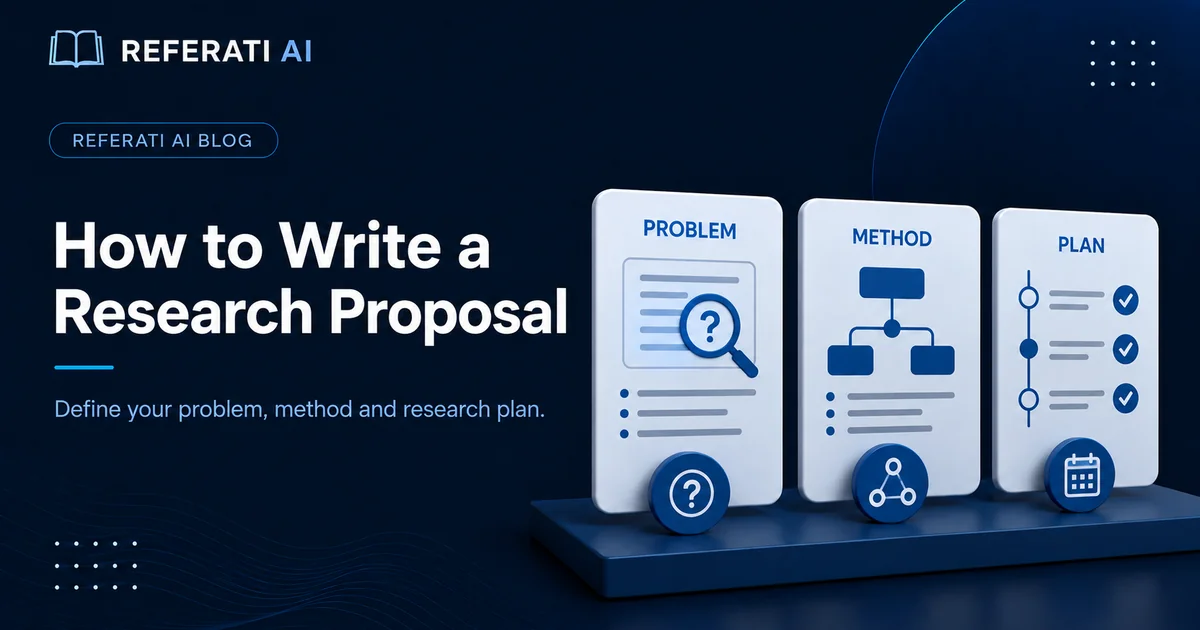
A solid research proposal contains at least seven main parts that guide the reader through your argument. These typically include an introduction, a literature review, your objectives, the methods, ethical considerations, a budget, and references. Your title and abstract are your first impression, and they have to be perfect.
Here’s a breakdown of the key components. A good proposal is the backbone of good research, and its structure isn't random.
- Title: Keep it concise, around 10 to 15 words. It should be specific, mention your key variables, and avoid jargon or abbreviations.
- Abstract: This might be the most important paragraph you write. Many reviewers read only the abstract before making an initial judgment. Keep it under 250 words.
- Introduction: Set the context. Explain the problem and state your research questions and hypothesis.
- Literature Review: Show you've done your homework. This section should synthesize existing research to identify the gap your study will fill.
- Research Design & Methods: Explain exactly how you will conduct your research. This is where you demonstrate the project is feasible.
- Ethical Considerations: Address any ethical issues and explain how you'll manage them.
- Budget & Timeline: Detail the costs and provide a realistic schedule for completion.
- References: List all the sources you've cited.
Write your abstract last. It's much easier to summarize the project once all the other sections are complete. This ensures your abstract perfectly reflects the final proposal.
While this structure is standard, always check the specific requirements of the institution or funder you're applying to. They can vary.
How Do I Build a Convincing Argument and Show the Research's Impact?
A convincing argument begins with a focused, single-sentence hypothesis that flows logically from your introduction. From there, outline two original, specific aims that are related but not dependent on each other. Most importantly, you must distinguish between your research "outputs" and its real-world "impact."
A strong hypothesis is the heart of your proposal. It should be a clear, testable statement. For example, a strong hypothesis about the Brca1 gene's role in cancer might be: "Overexpression of wild-type Brca1 in Brca1 null tumor cells will prevent metastatic dissemination in a mouse xenograft model." This is specific and sets up clear experiments.
Your specific aims are designed to test this hypothesis.
Avoid creating aims where the success of Aim 2 depends entirely on Aim 1. For instance, if Aim 1 is "Create a BRCA1-knockout mouse" and Aim 2 is "Conduct experiments on tissues from that mouse," your entire project fails if you can't create the mouse.
Perhaps the most overlooked part of a proposal is clearly defining its impact. Don't just list what you will produce; explain the change your work will create. Reviewers want to see that you understand this difference. They aren't just funding the creation of a paper; they're investing in the potential for meaningful change.
| What You Produce (Outputs) | The Change It Creates (Impact) |
|---|---|
| A published academic paper | A change in clinical guidelines |
| A new dataset | Improved public policy decisions |
| A workshop for teachers | An increase in local student literacy rates |
| A piece of software | More efficient data processing for a field |
What Common Mistakes Should I Avoid When Writing a Proposal?
One of the most frequent mistakes is writing a literature review that just lists and summarizes other studies. Your review should be a synthesis that identifies a clear gap in current knowledge. Another common pitfall is confusing research "outputs" with "outcomes" or "impacts."
Your literature review shouldn't read like a book report. Its job is to build a case for your own work by analyzing and connecting existing research to show what isn't known. You are guiding the reader to the exact spot where your research fits and why it's needed. Don't just summarize; synthesize and critique.
Another major error is failing to explain the real-world significance of your work. Many proposals describe their outputs (e.g., "we will publish three papers") but fail to articulate the outcomes or impact (e.g., "these findings will inform new policy for..."). The output is the product; the impact is the change that product makes.
Output: A dataset on water quality in a specific region. Impact: Local government uses the data to implement new filtration standards, leading to a measurable decrease in waterborne illnesses.
Finally, remember that a brilliant idea doesn't guarantee funding. A research proposal is a sales document. It needs clear, persuasive writing that convinces the reader your project is not only important but also feasible and that you are the right person to do it.
What Are the Technical Formatting Requirements for a Research Proposal?
While guidelines can differ, a common standard for many fellowships is an 8-page limit (excluding references), with 1.5 line spacing and a 12-point Times New Roman font. Any budget requests must be thoroughly justified, especially for expensive or non-standard equipment.
Getting the formatting right shows you're professional and can follow directions. It's a small thing that makes a big difference. For example, Yale University's guidance for STEM fellowships specifies these exact requirements: an 8-page limit for the main body, 1.5 line spacing, and 12pt Times New Roman font.
Your budget section also needs careful attention. It's not just a shopping list. Every item needs justification. If you request an expensive, high-end laptop, for instance, you must explain why a standard university computer is insufficient for your specific computational needs. The more expensive the item, the more detailed your justification must be.
Always, always, always find the specific formatting guidelines for the grant, fellowship, or program you're applying to. They are never suggestions. Deviating from them is one of the easiest ways to get your proposal discarded without being read.
Frequently Asked Questions
What are the main sections of a research proposal?
A standard proposal has a title, abstract, introduction (stating the problem), literature review (finding the gap), methods (explaining your plan), budget, timeline, and references. Each part builds on the last to argue that your project is important, credible, and achievable.
Why is the abstract so important?
The abstract is often the only part a busy reviewer reads closely at first. It must be a perfect, self-contained summary of your entire proposal—the problem, your approach, your methods, and your expected impact—all in under 250 words. It's your one-paragraph pitch.
How can I persuade reviewers to fund my proposal?
Focus on clarity and persuasion. Answer the key questions (problem, solution, impact) upfront. Show, don't just tell, why your research matters. Your proposal must be more than a plan; it must be a compelling argument that your work is necessary, you can do it, and it will make a difference.
What's the difference between "outputs" and "impacts"?
An "output" is the direct product of your research, like a published paper or a dataset. An "impact" is the broader change that happens because of your research, such as a new policy or a societal benefit. Funders want to see a clear path to impact.
How do I write a good hypothesis?
A good hypothesis is a single, testable sentence that proposes a relationship between variables. It should flow logically from the background you provide in your introduction. Instead of a question, it should be a declarative statement of what you expect to find through your research.
How detailed should my methodology section be?
Your methodology section needs to be detailed enough for another expert to understand and evaluate your approach. It should answer what you'll do, how you'll do it, and why you chose this particular method. It must convince the reader that your plan is sound and achievable.
Writing a proposal is tough, but tools can help. If you're looking for support with citations, structure, and academic phrasing, you might want to try referati.ai: an AI built for academic writing.