How to write a strong research hypothesis
Contents5
A good hypothesis is a specific, testable prediction about your research. For a hypothesis to be scientific, it must be falsifiable—a principle from philosopher Karl Popper (1934) that means a potential outcome could prove it wrong. Strong hypotheses are also specific. To get that clarity, many researchers use the PICOT framework (Population, Interest, Comparison, Outcome, Time) to turn a general question into a precise, testable statement before collecting any data.
What is a research hypothesis and why is it important?
A research hypothesis is your best, most educated guess about the relationship between two or more variables you plan to study. It’s a specific, testable prediction you make before you start collecting data. Think of a hypothesis as the central pillar that holds up your entire research project.
The word comes from the Greek hupothesis, meaning "foundation," and that’s exactly what it does. It provides a solid base for your investigation. In quantitative research, reviewers and supervisors will expect to see a clear hypothesis rather than just a general research question. This isn't just about academic tradition. A well-formed hypothesis forces you to think critically and specifically about what you're trying to discover. It guides your study design, your data collection methods, and the statistical tests you'll use for analysis.
Without a hypothesis, a study can feel directionless, like you're just collecting data to see what you find. While that approach might work for some exploratory research, most scientific work needs a clear claim to either support or reject. This process is the core of the scientific method, which uses systematic steps to reduce bias and get closer to the truth.
What makes a good research hypothesis?
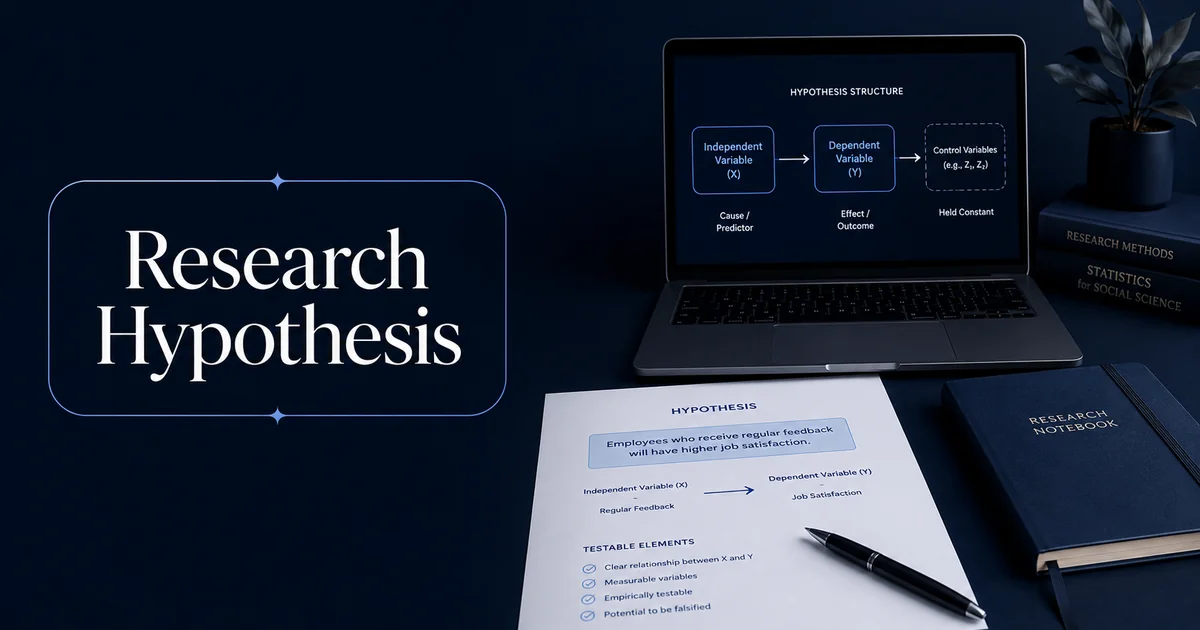
A strong hypothesis is clear, specific, and grounded in existing knowledge. It must have two key features: it has to be testable and falsifiable. A useful framework also suggests a good hypothesis follows the "5E rule": Explicit, Evidence-based, Ex-ante (made before the study), Explanatory, and Empirically testable.
Let's break down those two critical ideas. "Testable" is simple enough: you must be able to design a realistic study to check if your hypothesis is true. This means you need a way to measure your variables and see if a relationship exists between them.
"Falsifiable" is more subtle but just as important. The idea, defined by the philosopher Karl Popper in 1934, is that there must be a possible outcome of your study that would prove your hypothesis wrong. If there’s no way to disprove it, it isn't a scientific hypothesis. For instance, the statement "All swans are white" is falsifiable because finding just one black swan would disprove it completely.
A simple checklist for a strong hypothesis:
- Is it a clear "if-then" statement?
- Does it state the relationship between variables?
- Can you actually measure those variables?
- Could an experiment possibly prove it wrong?
Beyond these core principles, a good hypothesis is specific. It names the variables and often predicts the direction of the relationship. Finally, it should be based on existing theories or previous research. You aren't just guessing wildly. Your hypothesis is an informed prediction based on what is already known about the topic.
How do you turn a research question into a strong hypothesis?
You turn a broad research question into a strong hypothesis by making it specific and framing it as a testable statement. A powerful method for this is the PICOT framework, which is widely used in health sciences but is useful for almost any field. It helps you structure your thinking.
Your primary research question should always come first, and your hypothesis should be formulated to provide a testable answer to it. Crucially, this must all be set before you start analyzing data. The PICOT framework ensures every key component is considered:
- Population: Who are you studying? (e.g., undergraduate students, patients with type 2 diabetes)
- Interest/Intervention: What is the main factor or treatment you're investigating? (e.g., a new teaching method, a specific drug)
- Comparison: What is the alternative or control group? (e.g., the old teaching method, a placebo)
- Outcome: What are you measuring to see if there's an effect? (e.g., test scores, blood pressure levels)
- Time: Over what period will you track the outcome? (e.g., after 8 weeks, at 6 months)
Using this framework helps you move from a vague question like, "Does mindfulness help students?" to a specific, testable hypothesis. According to an article in the Journal of Emergencies, Trauma, and Shock, formulating this testable statement is the first real step in conducting original research. It turns a general curiosity into a focused scientific inquiry.
What common mistakes should you avoid when writing a hypothesis?
One of the most frequent mistakes is writing a vague or untestable hypothesis. Another common error is confusing the hypothesis with the prediction. Finally, a serious problem is forming your hypothesis after you've already looked at the data, a practice that undermines the entire scientific process.
It's easy to mix up a hypothesis and a prediction, but they are different. The hypothesis is the proposed explanation or mechanism. The prediction is the specific outcome you expect to see in your study if your hypothesis is correct.
Let's say you observe that asparagus plants grown near marigolds have fewer beetles.
- Hypothesis: Marigolds release a chemical that repels asparagus beetles. (This is the explanation).
- Prediction: If we plant asparagus next to marigolds, then we will find fewer beetles on those plants compared to asparagus planted alone. (This is the testable outcome).
Another major problem is being too general. A weak hypothesis can’t be properly tested. Look at the difference between a vague idea and a strong, specific one.
| Weak Hypothesis | Strong Hypothesis |
|---|---|
| "Mindfulness training will help students with stress." | "Students who complete a 4-week mindfulness training program will report significantly lower state-anxiety scores, as measured by the STAI-S inventory, one week after the intervention compared to students in a control group." |
The strong version is better because it specifies the population (students), the intervention (4-week program), the outcome measure (STAI-S score), and the comparison group. It's testable and falsifiable.
Never form your hypothesis after seeing the data. This practice, sometimes called HARKing (Hypothesizing After the Results are Known), can lead you to find patterns that are just due to random chance. You might end up reporting a "discovery" that isn't real. Always define your hypothesis first.
Frequently Asked Questions
What's the difference between a hypothesis, a research question, and a prediction?
A research question is the broad query your study aims to answer (e.g., "What is the effect of exercise on anxiety?"). A hypothesis is a specific statement proposing an answer (e.g., "Regular aerobic exercise reduces anxiety symptoms"). A prediction is the expected outcome of your experiment if the hypothesis is true.
What are the key features of a strong research hypothesis?
A strong hypothesis is testable, meaning you can design a study to evaluate it. It's also falsifiable, meaning some possible result could prove it wrong. It should also be specific, clearly stating the relationship between variables, and based on existing scientific literature or theory.
Does every research project need a hypothesis?
Not always. Quantitative studies that test for effects or relationships, like experiments, almost always require a hypothesis. However, qualitative or exploratory research, which aims to understand a topic in depth or generate new ideas, may start with broader research questions instead of a fixed hypothesis.
What is the PICOT framework and how does it help write a hypothesis?
PICOT stands for Population, Intervention, Comparison, Outcome, and Time. It’s a formula that helps you structure your thinking to create a specific and testable hypothesis. This framework forces you to define exactly who you're studying, what you're testing, what you're comparing it to, and what you'll measure.
What are null (H0) and alternative (H1) hypotheses?
In statistical testing, the null hypothesis (H0) states there is no effect or relationship between the variables (e.g., "The new drug has no effect on blood pressure"). The alternative hypothesis (H1) is what you are actually trying to prove—that there is an effect or relationship.
When should I use a directional hypothesis?
Use a directional hypothesis when previous research or a strong theory suggests a specific direction for the effect (e.g., "Method A will produce higher test scores than Method B"). If you're unsure of the direction, use a non-directional hypothesis (e.g., "There will be a difference in test scores").
What should I do if my research findings don't support my hypothesis?
This is not a failure. A result that disproves a hypothesis is just as valuable to science as one that supports it. Such a result helps refine theories and points future research in new directions. You should report your findings honestly and discuss why the results might have differed from your initial expectation.
If you're working on your next paper, a well-formed hypothesis is your starting point. For help structuring your ideas and building a solid research foundation, try referati.ai: an AI built for academic writing.