What to put in your thesis appendix
Contents
A thesis appendix holds supplementary materials that support your research but would disrupt the flow of your main text. This includes things like raw data, full interview transcripts, or blank copies of surveys. The appendix boosts your research's transparency and credibility. Each separate item should be labeled (e.g., Appendix A) and must be referenced in the main body of your thesis. Appendices usually don't count toward the final word count, but you must always check your specific university's guidelines on this.
What's the point of an appendix, anyway?
An appendix is a section at the end of your thesis for supplementary information. Its main purpose is to keep your core argument focused by moving non-essential but related materials—like raw data or long transcripts—to the back. This helps the reader follow your logic without getting sidetracked.
The goal of your main text is to present a clear, persuasive argument. Anything that clutters that story but is still important for context belongs in an appendix. It makes the text much easier to read. Think of it as a way to provide proof and background details for a curious or skeptical reader, like an examiner who wants to see the exact wording of a survey question. You don't force every reader to wade through it.
An appendix also serves another important function: it boosts your research's transparency. By including things like your raw data, research instruments, and ethics approval letters, you are showing your work. This allows others to check your methods, verify your findings, and maybe even replicate your study. This practice shows that your research is built on a solid foundation.
Imagine you're writing a psychology thesis on the effects of social media on anxiety. In your main text, you'd summarize your survey's results. The appendix is where you would put a blank copy of the actual survey you used, so other researchers can see the exact questions you asked.
What kind of material should go in the appendix?
A thesis appendix should only hold information that supports your research but isn't critical to understanding your main argument. It’s for supplementary material like blank surveys or raw data, not for hiding core analysis to meet a word count. Anything the reader must know belongs in the main text.
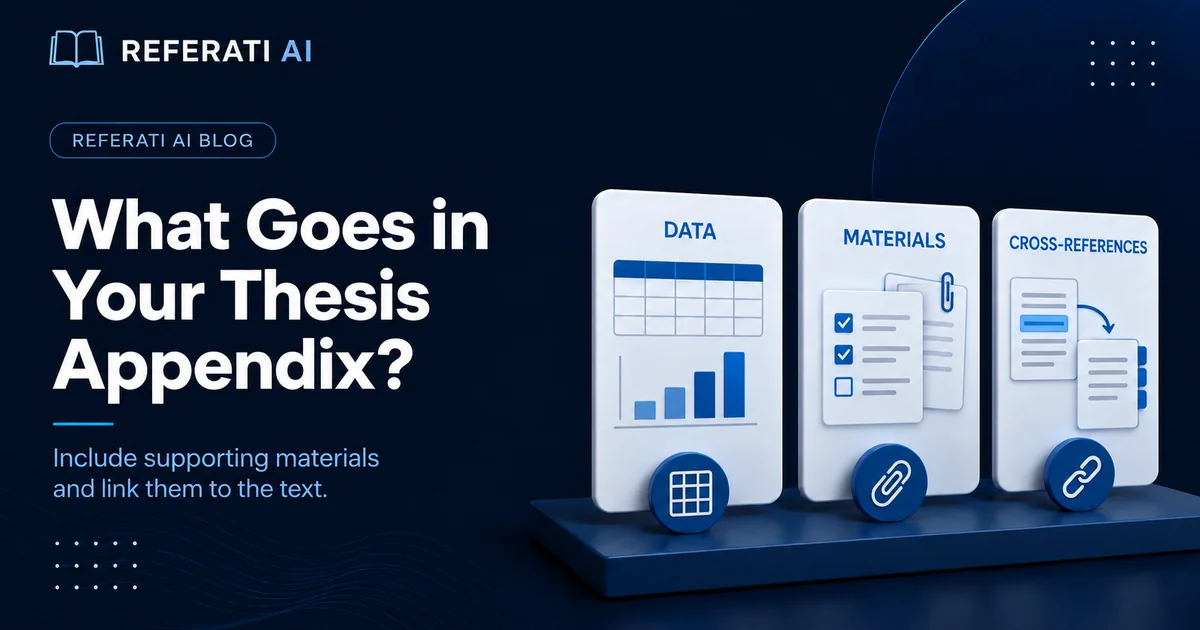
Common items that are perfect for an appendix include:
- Research Instruments: This includes blank copies of questionnaires, surveys, or interview schedules. It allows readers to see exactly what tools you used to collect your data.
- Raw Data: Large tables of raw statistical data, especially outputs from software like SPSS or R, belong here. In the main text, you should present summarized tables and figures that show your key findings.
- Transcripts: Full, anonymized transcripts of interviews or focus groups can go in the appendix. In your results chapter, you’ll use short, relevant quotes from these transcripts to support your points.
- Ethics Documents: Copies of your ethics approval letter from your university and blank participant consent forms are often required. This shows you followed proper ethical procedures.
- Other Materials: This can include letters of permission to conduct research, detailed technical diagrams, or lists of abbreviations if they are extensive.
| Belongs in the Main Body | Belongs in the Appendix |
|---|---|
| Your core argument and analysis | Raw data tables supporting the analysis |
| Interpretation of results | A blank copy of the survey used |
| Key figures essential for understanding | Full, anonymized interview transcripts |
| A summary of your methods | Ethics approval letters and consent forms |
What are the rules for formatting and referencing an appendix?
The formatting for a thesis appendix requires each item to start on a new page with a clear label (e.g., "Appendix A") and a title. As detailed in guides from DiscoverPhDs, every appendix must also be referenced at least once in the main text to justify its inclusion. This integrates it into your work.
If you have tables or figures within an appendix, their numbering should restart for each new appendix. For example, the first table in Appendix A would be "Table A1," and the first table in Appendix B would be "Table B1." This simple system prevents confusion with the tables and figures in your main chapters.
Most importantly, every single appendix must be mentioned at least once in the main body of your thesis. You can’t just add an appendix and hope your reader finds it. You need to direct them to it. For instance, you might write, "The full set of interview questions can be found in Appendix A." If you have multiple appendices, you should list them in the order they are first mentioned in your text.
A common mistake is adding appendices without ever referring to them in the main text. An unreferenced appendix is technically not part of your thesis. Make sure you signpost every one.
How do I check my university's specific rules for an appendix?
General rules for a thesis appendix exist, but your university’s guidelines are the final authority. Specifics on formatting, word count inclusion, and placement after the reference list can vary widely. Always find and follow your institution's official thesis handbook to avoid any last-minute formatting problems.
One of the biggest variables is the word count. Most universities do not include appendices in the final word count, but some do. They may even have a limit on the size of the appendix itself. Don't assume anything. Verify the policy. A guide from MyPerfectWriting notes this is one of the most common points of confusion for students.
Placement is another variable. Typically, appendices come after the reference list or bibliography. But some universities have their own unique order. For instance, some guidelines state that appendices should be placed after the bibliography but before the curriculum vitae. Formatting details like margins, font size, and page numbering might also have specific requirements. The only way to be sure is to find your university's official thesis submission guide and follow it precisely.
Before you even start formatting, find your university's "Thesis Submission Guidelines" document. Save it, print it, and treat it as your most important resource. It will save you hours of stress and last-minute corrections.
What are the most common mistakes to avoid?
The most serious mistake is using an appendix to bypass the word count by hiding essential analysis or literature review there. Examiners can easily spot this. If the information is critical for understanding your argument, it absolutely must stay in the main body of the thesis.
Another error is using the appendix to dump irrelevant information in an attempt to make the thesis look more substantial. The appendix isn't a junk drawer. Every item you include should have a clear purpose and be directly relevant to the research you've presented. If it doesn't add value or support your methodology, leave it out. Examiners rarely read appendices cover-to-cover; they use them to check specific points.
Finally, a simple but common mistake is forgetting to refer to the appendix in the main text. As mentioned before, every appendix needs to be signposted. For example, "A full breakdown of the demographic data is available in Appendix C." This reference acts as a bridge, connecting the supplementary material to the main narrative and showing the reader why it's there. Without that link, the appendix is just floating in space.
Frequently Asked Questions
Why is an appendix important for a dissertation?
An appendix is important because it provides a space for supplementary material that supports your research without cluttering the main text. It enhances transparency by allowing readers to examine your raw data or research instruments, which strengthens the credibility and methodological rigor of your work.
What kind of material should never go in an appendix?
You should never put your core argument, key findings, data analysis, or literature review in an appendix. If the information is essential for a reader to understand your conclusions, it belongs in the main body of the thesis, regardless of the word count.
How should I title and number my appendices?
Each appendix should start on a new page and be labeled with a letter (e.g., "Appendix A," "Appendix B") and a descriptive title (e.g., "Appendix A: Survey Instrument"). If you only have one, simply title it "Appendix." This helps readers quickly find the information they're looking for.
Does the appendix count towards the overall word limit?
In most cases, the appendix does not count toward a thesis's final word count. However, this is not a universal rule. Some universities or departments have different policies, so you must always check your institution's specific guidelines to be sure.
Where should I place the appendix in my dissertation?
The appendix is typically placed at the very end of the document, after the reference list or bibliography. Again, university guidelines can vary, so consult your department's official style guide for the correct placement before you submit your work.
Is it necessary for every appendix to be mentioned in the main text?
Yes, absolutely. Every appendix you include must be referred to at least once in the main body of your thesis. This reference justifies its inclusion and directs the reader to the supplementary information when it’s relevant to the point you're making.
Can I include raw data in the appendix?
Yes, the appendix is the perfect place for large tables of raw data, statistical outputs, and other dense numerical information. This keeps your main chapters focused on the summarized findings and analysis, while still making the full dataset available for review.
Struggling to organize your research and references? It might be worth a look. Try referati.ai: an AI built for academic writing.