How to write a thesis statement that carries your whole essay
Contents5
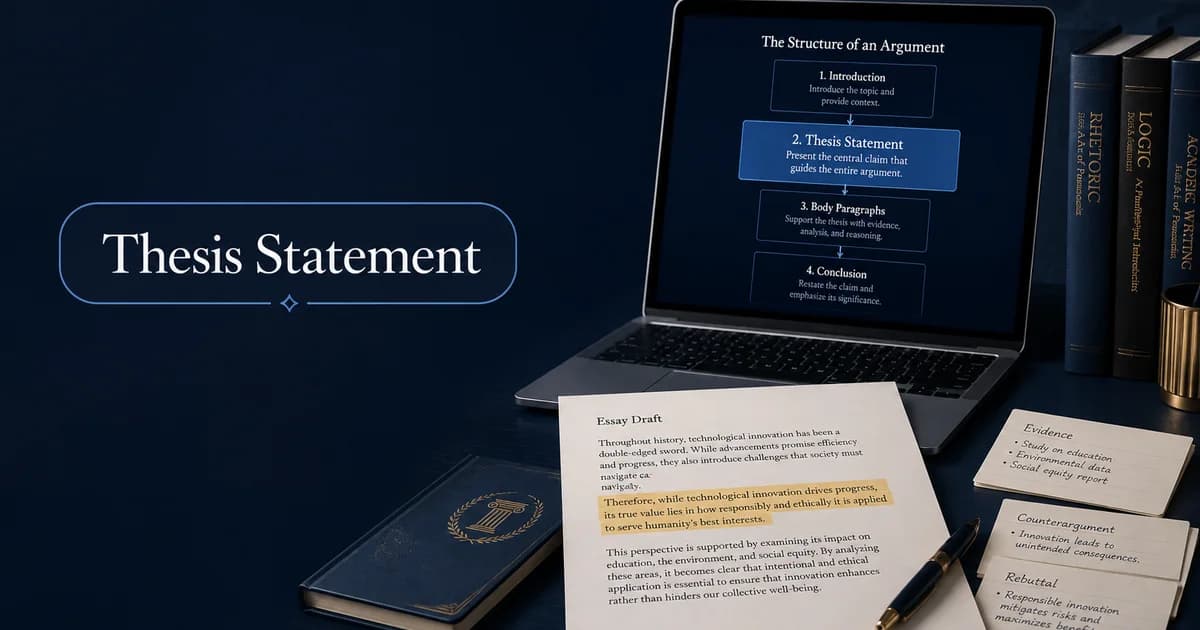
A strong thesis statement is a single, debatable sentence stating your main argument, typically found at the end of your introduction. It's not a fact; it's a specific claim that guides your entire essay. A helpful formula is Topic + Your Position + Supporting Reasons. For example, instead of saying "Social media affects students," a strong thesis would argue how: "While social media can improve motivation, its constant notifications harm focus during study sessions."
Why is a thesis statement the backbone of your essay?
Think of your thesis statement as the central pillar holding up your entire paper. A thesis statement is typically a single sentence near the end of your introduction that tells your reader exactly what you're going to argue. According to the UNC Writing Center, it serves as a "road map" for the rest of your paper, setting expectations and guiding the reader.
A thesis does more than just state your topic; it presents your specific interpretation or claim about it. This is the core idea that every paragraph in your essay will work to support, explain, and defend. Without a clear thesis, an essay can feel unfocused and wandering, leaving your reader confused about your point. A strong one gives your writing purpose and direction from the very beginning.
It answers the reader's silent question: "So what?" A good thesis shows them why your subject matters and what you've concluded about it. This is why it isn't just a statement of fact but a claim that reasonable people could disagree on. Your job in the rest of the paper is to convince your reader that your claim is valid, using evidence and analysis to prove it.
Your thesis isn't set in stone the moment you write it. Most writers start with a "working thesis" that they refine and adjust as they research and write. It's a tool that evolves with your understanding of the topic.
How do you build a strong thesis statement, step-by-step?
The best way to arrive at a strong thesis is through a process of refinement. You start with a broad topic, do some initial research to find a specific angle, draft a "working" thesis, and then sharpen it into a final, arguable claim. A helpful formula to follow is Topic + Position/Claim + Supporting Reasons.
Let's walk through an example. Imagine your assignment is about public health in schools.
- Start with a broad topic: Sugar consumption among children. This is too big for a single essay. You need to narrow it down.
- Narrow it with research: You discover that American elementary school students often consume far more sugar than recommended daily amounts, frequently from vending machines at school. This gives you a specific problem to address.
- Draft a working thesis: Schools should do something about the high sugar consumption from their vending machines. This is better, but it's still a bit vague. What should they do? And why?
- Refine it into a specific, arguable claim: Now you can apply the formula.
- Topic: Vending machine offerings in schools.
- Position/Claim: Schools should be required to replace sugary drinks.
- Supporting Reason: Because a high percentage of students consume excessive sugar, and healthy alternatives are available.
Final Thesis: "Given that nearly half of American elementary school children consume up to nine times the recommended daily amount of sugar, schools must be required to replace soda in vending machines with healthier alternatives to combat childhood obesity and improve student concentration." This thesis is specific, debatable, and lays out a clear path for the essay. A guide from Indiana University offers more examples of how to move from a general topic to a focused thesis.
What makes a thesis statement strong vs. weak?
A strong thesis statement is clear, specific, and, most importantly, arguable. It stakes out a position that isn't just a statement of fact. A weak thesis, on the other hand, is often too broad, states an obvious fact, or simply announces the paper's topic without making a real claim about it.
The best thesis statements have a few key attributes. They take on a subject that people could reasonably have differing opinions on, and they deal with a topic that can be covered adequately in the space of your essay. They also express one main idea and assert your conclusions about a subject. Let's look at some direct comparisons.
| Weak Thesis Statement | Strong Thesis Statement |
|---|---|
| It's a fact: William Shakespeare wrote Hamlet in the early 1600s. | It's an argument: Hamlet's tragic flaw stems from his intellectual overthinking, not a moral weakness, making him a distinctly modern protagonist. |
| It's too broad: Social media has an effect on students. | It's specific: While social media platforms can improve student motivation through collaborative projects, their constant notifications actively harm the ability to focus during study sessions. |
| It's a question: Should cities invest in public transportation? | It's an answer: Cities should prioritize funding for public transportation over road expansion because it reduces traffic congestion and lowers carbon emissions. |
A weak thesis often leads to a descriptive paper that just lists facts. A strong one leads to an analytical or argumentative paper that proves a point.
Avoid using first-person phrases like "I believe" or "In my opinion." These phrases weaken your argument by making it sound like a personal belief rather than a well-supported claim. State your thesis with confidence.
What common mistakes should you avoid when writing a thesis?
Many students make a few common errors that weaken their thesis from the start. A study by Cambridge Proofreading found that mistakes in thesis construction account for many lower grades. The most frequent errors are stating a simple fact, using vague language, or treating the first draft as final.
The most common mistake is stating a fact instead of an argument. A sentence like "The internet changed how people get information" is a fact. It's not debatable. A better thesis would argue how or why that change is significant in a specific context. Your thesis needs to be an interpretive claim that you can back up with evidence.
Another frequent error is using vague, fuzzy language. Avoid words like "aspects," "factors," "things," or "important." A thesis like "Technology has many important aspects for education" tells the reader almost nothing. What technology? What aspects? Be specific.
Finally, students sometimes believe their first draft of a thesis is final. As scholar Altynay Karatayeva notes, "Thesis construction errors affect paragraph organization, evidence selection, and argumentative coherence, reducing overall essay quality regardless of writing skill or research depth." Don't be afraid to revise your thesis to better reflect the argument you’ve developed in your paper. It’s a sign of thoughtful writing.
Frequently Asked Questions
What is the main purpose of a thesis statement?
The main purpose of a thesis statement is to present your central argument or claim in a single, concise sentence. It acts as a guide for your reader, telling them what to expect from your essay and how you interpret the significance of your topic.
Where should a thesis statement be placed in an essay?
A thesis statement is usually the last sentence of your introductory paragraph. Placing it here allows you to set the context first and then deliver your main argument, which the rest of the essay will go on to support. This isn't a strict rule, but it's a very common convention.
How can I tell a strong thesis statement from a weak one?
A strong thesis is specific, focused, and arguable—it makes a claim that someone could reasonably challenge. A weak thesis is often too broad, states an obvious fact, is phrased as a question, or simply announces the topic without taking a stance.
Can my thesis statement change while I'm writing the essay?
Yes, a thesis statement can and often should change. Most writers start with a "working thesis" and revise it as they research and develop their argument. Revising your thesis to better match the final direction of your paper is a normal part of the writing process.
What's the difference between argumentative, explanatory, and analytical theses?
An argumentative thesis makes a debatable claim you aim to prove (e.g., "Governments should fund green energy"). An explanatory thesis aims to explain a topic to the reader (e.g., "A star's life cycle depends on its initial mass"). An analytical thesis breaks down an idea to evaluate it (e.g., "The symbolism in The Great Gatsby critiques the American Dream").
Why can't a fact be a thesis statement?
A fact is an undisputed statement, so there's nothing to argue or prove in an essay. The goal of academic writing is to present an original interpretation or analysis, not to list facts. A strong thesis must be a claim you can defend with evidence and reasoning.
Crafting a strong thesis takes practice, but it’s a skill that will improve every paper you write. Once you have a solid thesis, the next step is building the argument around it. If you're looking for help organizing your research and structuring your essays, you might find referati.ai useful—it's an AI writing tool designed for academic work.