How to write the methodology chapter of your thesis
Contents5
Your thesis methodology is your research's master plan. It explains exactly how you conducted your study and justifies why you chose that specific approach. This chapter must be solid, as studies show that around 30% of academic papers are rejected because of a weak methodology. A good one answers two main questions: how did you collect your data, and how did you analyze it? Think of methodology as the overall strategy and methods as the specific tools you used to get the job done.
Why does the methodology chapter matter so much?
The methodology chapter proves your research is credible. It’s not just a list of steps; it's a detailed argument for why your approach was the best way to answer your research question. A flawed methodology is a top reason for rejection, with some estimates suggesting it's behind nearly 30% of rejected academic papers.
A well-written methodology allows other researchers to understand, evaluate, and even replicate your study. This transparency is a basic principle of good academic work. You aren't just describing what you did. You're showing the reader you thought carefully about the process and that your results are reliable and valid.
This section connects your research aim and questions to your data, forming a logical chain that runs through your entire thesis. While it's often shorter than other chapters, its influence is enormous. Get this part right, and you build a strong foundation for your findings.
Don't over-explain common procedures. Assume your reader has a basic understanding of research. Instead of explaining what a survey is, focus on why a survey was the right tool for your specific question and how you designed it.
What's the difference between "methodology" and "methods"?
Your methodology is your overall strategy or logical plan for answering your research question. Your methods are the specific tools and procedures you use to carry out that plan. It’s the difference between the architect's blueprint (methodology) and the contractor's actual tools (methods).
Many people use these terms as if they mean the same thing, but they don't. Understanding the difference is key to writing a clear chapter.
| Methodology (The Plan) | Methods (The Actions) |
|---|---|
| The "why." The overall research strategy and rationale. | The "how." The specific tools and steps used to gather data. |
| Explains the theoretical framework guiding the research. | Describes the practical techniques like surveys, interviews, or experiments. |
| Justifies the choice between qualitative, quantitative, or mixed approaches. | Details the exact procedures for sampling, data collection, and analysis. |
Your methodology is the big-picture thinking. Are you taking a quantitative approach, focusing on numbers and statistics to find general patterns? Or is your study qualitative, using interviews or observations to explore experiences and meanings in depth? Your chosen methodology must align with your research philosophy and what you're trying to discover.
Your methods are the practical steps you take within that framework. If you're doing a qualitative study on how students feel about AI feedback, your methods might involve semi-structured interviews and thematic analysis.
Avoid mismatches between your research philosophy and your methods. For example, using a large-scale, closed-question survey (a quantitative method) to explore a topic from an interpretive perspective (which seeks deep meaning) shows a fundamental misunderstanding that will undermine your credibility with examiners.
What ethical issues should I consider in my methodology?
If your research involves people in any way (through interviews, surveys, or observations), you must detail the ethical steps you took to protect them. This section shows that you conducted your research responsibly. Many universities require this before you even start collecting data.
For any study with human participants, you will probably need formal approval from an ethics committee or Institutional Review Board (IRB). In your methodology, you should state that you received this approval. You'll need to describe how you got informed consent, making sure participants knew what the study involved and that they could withdraw at any time.
Confidentiality is also key. You have to explain how you protected participants' identities, for example, by removing names from transcripts or using fake names. These steps aren't just red tape. They are central to producing valid research. If participants feel pressured or aren't fully informed, their answers may be biased, affecting your results.
What is the structure of an effective methodology chapter?
A good methodology chapter is direct, precise, and always written in the past tense, since you are reporting on work you’ve already done. It must clearly answer two key questions: how did you collect your data, and how did you analyze it? There's no single perfect structure, but a logical flow is a must.
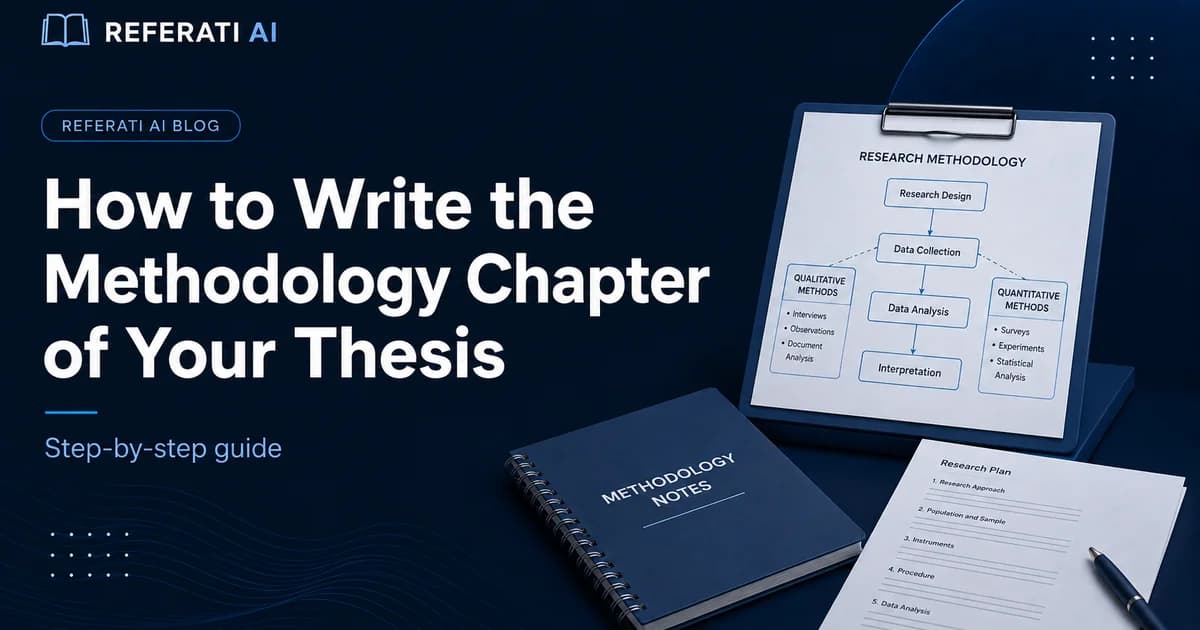
Start by briefly restating your research question. This reminds the reader of your goal. Then, describe your overall research design. Was it quantitative, qualitative, or mixed-methods? Was it experimental, descriptive, or correlational? Justify this choice.
Next, detail your data collection methods. Who were your participants, and how did you select them? What instruments did you use, like surveys or interview questions? Provide enough detail so someone else could repeat your study. After that, explain your data analysis procedures. Don't just name the software you used; describe the specific statistical tests or thematic analysis steps you took. Finally, it’s good practice to briefly discuss the limitations of your chosen methods. Acknowledging limitations shows you have a realistic view of your work.
Hypothetical Methodology for a Quantitative Study: This study investigated the link between social media use and academic performance among undergraduates using a quantitative, correlational design. We collected data via an online survey distributed to 150 students from three universities, selected through convenience sampling. The survey included demographic questions and the Social Media Addiction Scale. We then analyzed the data using SPSS to run a Pearson correlation test.
Keep in mind that your first draft will almost certainly need changes. You'll need to revise it after you've collected and analyzed your data to reflect what actually happened, including any unexpected issues you had to solve along the way.
Frequently Asked Questions
What is the main purpose of a methodology chapter?
The methodology chapter's main purpose is to explain and justify how you conducted your research. It proves your findings are reliable by showing you used a sound design. This transparency allows other researchers to trust, evaluate, and even try to replicate your work.
What's the difference between "methodology" and "methods"?
Methodology is the overall strategy or "plan" for your research, providing the rationale for your approach. Methods are the specific tools and procedures you use to execute that plan, like surveys or interviews. It’s the difference between the "why" and the "how."
What tense should the methodology section be written in?
You should always write the methodology chapter in the past tense. You are reporting on research that you have already completed. The tone should be direct and formal, using simple language wherever possible to maintain clarity and precision.
Why are ethical considerations important in the methodology?
Ethical considerations are vital for protecting the rights and well-being of research participants. This involves getting informed consent, ensuring confidentiality, and minimizing harm. It also helps reduce bias, which strengthens the credibility and validity of your research findings.
What does a typical methodology chapter structure look like?
You usually start by restating your research problem and overall approach. Then, you describe your participants and sampling methods. After that, you detail your data collection procedures and, finally, your data analysis techniques. Many researchers also include a discussion of their study's limitations.
How do I ensure my methodology is reliable and valid?
To ensure reliability, describe your steps so clearly that another researcher could replicate them and get similar results. For validity, you must justify every choice, explaining why your specific methods were the most appropriate ones for answering your particular research question.
Drafting a thesis is a marathon, and the methodology chapter can be one of its most challenging parts. If you're trying to structure your arguments and clarify your research plan, an AI academic writing partner like referati.ai might help you organize your thoughts and make sure you've covered all the necessary components.