The most common thesis mistakes and how to avoid them
Contents5
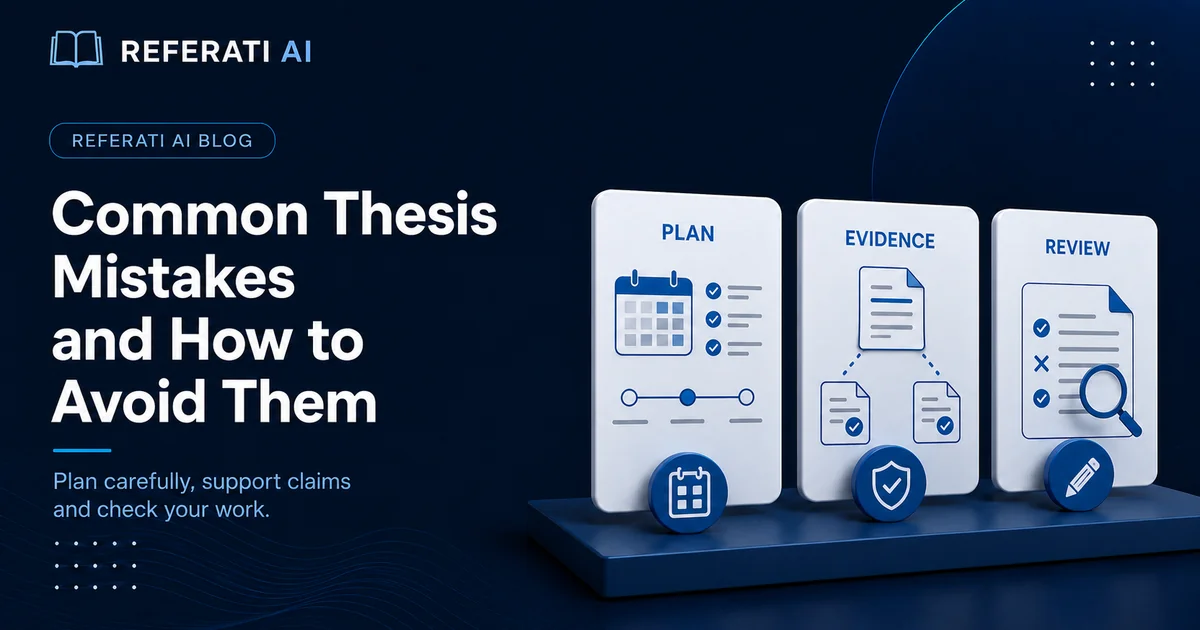
The most common thesis mistakes are avoidable and usually fall into three categories. First, a vague thesis statement, a problem that sources suggest over 60% of students struggle with. Second, a weak literature review that just lists studies instead of building an argument. Third, major statistical errors. One study found only 24.5% of dissertations used appropriate stats, with a shocking 82.3% misinterpreting their results. Avoiding these pitfalls means focusing your topic, thinking analytically, and getting statistical help early.
How does a poor topic or a vague thesis hurt your paper?
Choosing a topic that's too broad or having a weak thesis statement is one of the fastest ways to derail your project. A vague thesis is often cited as one of the top mistakes that weaken student essays, making your research unmanageable and your argument impossible to prove within the constraints of a paper.
A strong thesis needs to express one single, clear idea. If your topic is something like "organizational culture and productivity," you've given yourself an impossibly huge field to cover. What kind of organizations? Which country? What aspects of culture? What do you mean by productivity? This lack of focus leads to a paper that skims the surface of many things but explores nothing in depth. Your goal is to find a research question that is specific enough to be answered thoroughly within the scope of your project.
A PhD student initially proposed the topic "organizational culture and productivity in companies." After discussion with their supervisor, they narrowed it down to "the impact of reward systems on productivity in mid-sized tech startups." This change made the research focused, manageable, and ultimately publishable.
The thesis statement is the backbone of your entire paper. It's not just a topic; it's an arguable claim that you will spend the rest of your paper proving. A weak thesis is often just a statement of fact or a broad declaration. A strong one takes a specific, debatable position.
| Weak Thesis Statement | Strong Thesis Statement |
|---|---|
| This paper will discuss the effects of social media on teenagers. | The daily use of platform-based social media by teenagers contributes to lower self-esteem and increased anxiety by promoting constant social comparison. |
| Climate change is a global problem. | Governments must implement carbon pricing policies because they are the most economically efficient method for reducing greenhouse gas emissions. |
| Organizational culture is important for company success. | A transparent and feedback-oriented organizational culture is a more significant driver of employee retention in tech startups than competitive salaries. |
Getting this part right from the beginning saves you countless hours of unfocused research and painful rewrites later on. It provides a roadmap for your writing and a clear benchmark for every piece of evidence you include.
How do you avoid a weak literature review and statistical errors?
Your literature review should be an argument, not a shopping list of summaries. The most common feedback supervisors give is that "it reads like a list." An effective review synthesizes previous research to identify a gap or build a case for your own work. It's about putting sources in conversation with each other.
A descriptive review simply says, "Smith (2020) found X. Jones (2021) found Y. Brown (2022) found Z." An analytical review, on the other hand, would say, "While Smith (2020) and Jones (2021) both identified X as a key factor, they overlooked the influence of Y, a gap later highlighted by Brown (2022). My research builds on Brown's work by..." This shows you understand the field, not just that you've read the articles.
Statistical errors are another massive, often hidden, problem. A critical review of 62 doctoral dissertations at Cairo University's National Cancer Institute found that statistical methods were appropriate in only about a quarter of them (24.5%). Worse, the results in over 82% of the papers were misinterpreted. A separate 2024 study of 1,400 master's theses found that 47% of statistical errors involved choosing the wrong test for the hypothesis. These numbers are high.
Common statistical mistakes include reporting only a p-value without the effect size, ignoring the assumptions of a statistical test, or confusing statistical significance with real-world, practical importance. These errors can invalidate your conclusions entirely.
So, how do you avoid this? If your research is quantitative, consulting with a statistician early in the process is a very good idea. They can help you with your research design, sample size calculation, and analysis plan. Don't fall into the trap of thinking more data is always better. Focus on collecting the right data to answer your specific research question.
What are the most common violations of academic integrity?
Academic research is built on a foundation of integrity, and there is zero tolerance for cutting corners. While blatant cheating is rare at the thesis level, more subtle violations can happen, often unintentionally. The most common issues are plagiarism, improper citation, and using unreliable sources.
Plagiarism isn't just copying and pasting a whole paragraph. It can be as simple as using someone else's specific idea or phrasing without giving them credit, even if you change a few words. Students often get into trouble when they're taking notes and forget to mark down where an idea came from. By the time they start writing, the borrowed idea feels like their own. This is still plagiarism.
When in doubt, cite it. It is always better to have too many citations than to be accused of plagiarism. Keep meticulous notes and record the source for every piece of information you gather.
Using unreliable sources is another pitfall. A blog post or a random website isn't an appropriate source for an academic thesis. You need to rely on peer-reviewed journal articles, scholarly books, and official reports. Learning to distinguish between popular sources and academic ones is a key skill you'll develop.
Finally, ignoring the specific formatting and citation style requirements (like APA, MLA, or Chicago) can also be seen as a form of academic sloppiness. These rules exist for a reason: they create clarity and consistency, allowing others to find your sources and verify your work. Tools built for academic writing can help manage citations and formatting, preventing these simple but frustrating errors.
How can you effectively manage the thesis writing process?
Effectively managing a thesis means treating it as a circular, not linear, process. The best strategies are breaking the project into small tasks, communicating regularly with your supervisor, and fighting perfectionism by writing a "bad" first draft. This approach prevents procrastination and keeps the project moving forward.
One of the biggest obstacles isn't intellectual, but emotional: perfectionism. The desire to make every sentence perfect on the first try can lead to intense stress and procrastination. It's better to get a messy "draft zero" down on paper than to stare at a blank page for weeks. You can't edit what you haven't written. Give yourself permission to write a bad first draft.
A common experience is a crisis of confidence after data analysis. One PhD candidate described it as a moment when "everything made sense, but suddenly nothing did." This feeling of being lost in your own data is normal. It's a sign that you are deeply engaged with the complexity of your topic.
Managing your time and your relationship with your supervisor is also critical. Don't disappear for months and then show up with a full draft. Regular, short meetings with specific questions and small pieces of writing for feedback are far more productive. Your supervisor is your guide, but they can't help you if you don't communicate with them. Break the massive project of "writing a thesis" into tiny, manageable tasks: "find five papers on X," "write 300 words for the methods section," or "create a table for my results." This makes the process feel less overwhelming and helps you build momentum.
Frequently Asked Questions
How do I choose a good, manageable topic for my thesis?
Start with a broad area of interest, then narrow it down by asking specific questions. Consider the population, timeframe, location, and specific variables you want to study. A good thesis topic is one that genuinely interests you and is narrow enough to be covered thoroughly in the time you have.
What is a strong thesis statement and how do I create one?
A strong thesis statement is a single, clear, and arguable sentence that presents your main claim. It's not a fact or a question. To create one, start with your research question and then propose a specific, debatable answer to it that you will defend with evidence throughout your paper.
What's the difference between summarizing and synthesizing in a literature review?
Summarizing simply reports what one author said. Synthesizing connects ideas from multiple authors, showing how they relate, conflict, or build on one another. An effective literature review focuses on synthesis to build an argument for your research and identify a gap in existing knowledge.
How can I avoid plagiarism and make sure I'm citing correctly?
Always cite your sources for any idea, statistic, or phrase that is not your own original thought. Keep detailed notes with source information as you research. Use a citation manager to keep track of your sources and learn the specific citation style required by your university (e.g., APA, MLA).
What are the most common statistical errors and how do I avoid them?
The most common errors include choosing the wrong statistical test, misinterpreting p-values, and ignoring test assumptions. To avoid them, plan your analysis before you collect data and consult with a statistician or a knowledgeable faculty member if you are unsure about your methods.
How do I manage my time effectively while writing a thesis?
Break the project into small, concrete tasks. Set realistic weekly goals instead of vague long-term ones. Schedule regular writing sessions and treat them like appointments you can't miss. And remember to communicate regularly with your supervisor to stay on track and get feedback.
If you're looking for a tool to help you handle the challenges of academic research and writing, from structuring your arguments to managing citations, you might want to try referati.ai: an AI built for academic writing.