How to choose a sample for your research
Contents5
Choosing the right sample is key for credible research. A good sample must be adequate (large enough for reliable results) and representative (a mirror of your larger population). Your main choice is between probability sampling, where everyone has a known chance of being picked, and non-probability sampling for more exploratory work. Specific methods like stratified sampling ensure all subgroups are included, while cluster sampling helps cut costs for geographically spread-out groups. The biggest danger to avoid is selection bias, which can sneak in and invalidate your entire study.
Why is a good sample so important for your research?
A good sample determines if your conclusions are valid. The process of sampling involves selecting a smaller, manageable group from a larger population to study. A well-chosen sample makes your research more efficient and accurate, saving you time and money while reducing the risk of error.
A solid sample has two key features: adequacy and representativeness. Adequacy means your sample is large enough to give you confidence in your findings, but not so large that you waste resources. Representativeness means your sample mirrors the larger population's key traits. For example, if you're studying a population that is 50% male and 50% female, your sample should reflect that ratio. Without these qualities, your results might not apply to the broader group you claim to be studying. A bad sample can undermine everything.
Imagine you want to study the academic performance of all university students in a country. Randomly selecting 500 students from the national university database is an example of simple random sampling. This gives every student an equal chance of being included, making the sample likely to be representative.
What are the different types of sampling, and how do I pick one?
The main choice you'll make is between probability and non-probability sampling. In probability sampling, every member of your target population has a known, non-zero chance of being selected. This is the gold standard if you want to generalize your findings to the whole group with statistical confidence.
Probability sampling methods are designed to be unbiased. The simplest form is simple random sampling, where everyone has an equal shot, like drawing names from a hat. Other probability methods include stratified, systematic, and cluster sampling, each with its own specific use depending on your population and research question.
Non-probability sampling, on the other hand, doesn't give everyone an equal chance. These methods (like convenience, purposive, or snowball sampling) are often used when creating a truly random sample is impossible or impractical. They can be very useful for exploratory research or when you need to find a specific, hard-to-reach group. The trade-off is that you can't statistically generalize your findings to the broader population.
| Method Type | Key Feature | When to Use It |
|---|---|---|
| Probability Sampling | Every member has a known, non-zero chance of selection. | When you need to make statistically valid conclusions about the entire population. |
| Non-Probability Sampling | Selection is based on convenience, judgment, or other non-random criteria. | For exploratory research, case studies, or when the population is hard to access. |
What are the pros and cons of different probability techniques?
Each probability sampling technique has its own strengths and weaknesses. Stratified sampling is great for ensuring subgroups are properly represented. It involves dividing your population into groups (or "strata") based on shared traits like age or income, then taking a random sample from each group.
Systematic sampling is simpler. You just pick a random starting point on a list and then select every "nth" person. It's fast and easy, but it has a hidden danger: periodicity bias. If your list has a recurring pattern that lines up with your sampling interval (for example, every 10th person on an employee list is a manager), your sample will be biased.
Cluster sampling is a lifesaver for large, geographically dispersed populations. Instead of listing every individual, you divide the population into clusters (like cities or schools), randomly select some clusters, and then survey everyone within them. This method significantly reduces travel costs and logistical headaches, though it can introduce more sampling error than other methods.
The World Health Organization's "30-cluster" sampling technique is a famous real-world application. It's widely used in public health to efficiently assess things like immunization coverage without having to survey every single village in a region.
How do I avoid bias and make my sample better?
The biggest enemy of a good sample is bias. Sample selection bias happens when your method for picking participants is accidentally related to the outcome you're measuring. For instance, if you're studying a job training program and only survey people who completed it, you're creating a biased sample by excluding those who dropped out.
One of the most common sources of bias comes from convenience sampling. This is when you survey people who are easy to reach, like students in your university class or shoppers at a single mall. While convenient, this method severely limits your ability to generalize the findings because your sample systematically excludes most of the population. Your results might only apply to that specific, convenient group.
Don't fall into the trap of thinking a bigger sample is always better. While a tiny sample will have high variability, a massive one can waste resources without adding much precision. The goal is a sample that is adequate and representative, not just huge.
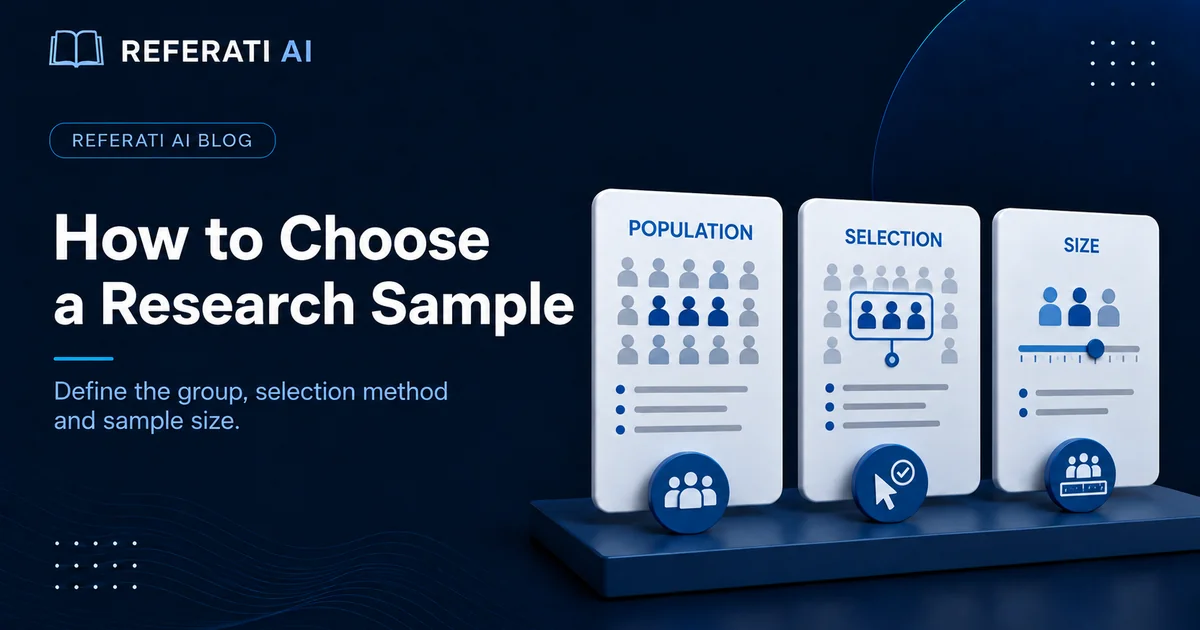
To improve your sample quality, first, define your target population clearly. Who exactly are you trying to study? Second, choose a sampling frame (the list you'll draw your sample from) that covers that population as completely as possible. Finally, use a random sampling method whenever your goal is to generalize results. Being deliberate and transparent about your sampling methods is the backbone of good research.
Frequently Asked Questions
What's the difference between quantitative and qualitative data collection?
Quantitative data involves collecting numbers that can be analyzed statistically, like survey ratings or test scores. Qualitative data is non-numerical and descriptive, such as interview transcripts or observational notes, and it's used to understand concepts, thoughts, or experiences in depth.
Why is sampling so necessary in research?
It's usually impossible or impractical to study an entire population. Sampling allows you to gather data from a smaller, manageable subset. A well-chosen sample lets you make reliable inferences about the whole group, saving significant time, money, and effort.
When should I use probability sampling instead of non-probability?
Use probability sampling when you need to make statistically valid generalizations about a whole population. If your goal is for your results to be representative and projectable onto the larger group with a known margin of error, probability sampling is the correct approach.
What are "target population" and "research population"?
The "target population" is the entire group you want to draw conclusions about (e.g., all primary school students in a country). The "research population," sometimes called the accessible population, is the group from which you can actually draw your sample (e.g., students from accessible schools).
How can my sample choice lead to bias?
Bias occurs if your sample isn't representative of your population. This can happen if you use convenience sampling, if many people refuse to participate (non-response bias), or if your sampling frame is incomplete. This skews your results, making them an inaccurate reflection of the real world.
What is the main advantage of stratified random sampling?
The main advantage of stratified sampling is that it ensures all important subgroups of a population are adequately represented in your sample. This is particularly useful for highlighting differences between groups and for studying minority groups that might be missed by simple random sampling.
Thinking through these steps can feel overwhelming, but getting the design right is half the battle. If you're looking for a tool to help organize your thoughts and citations, you could try referati.ai: an AI built for academic writing.