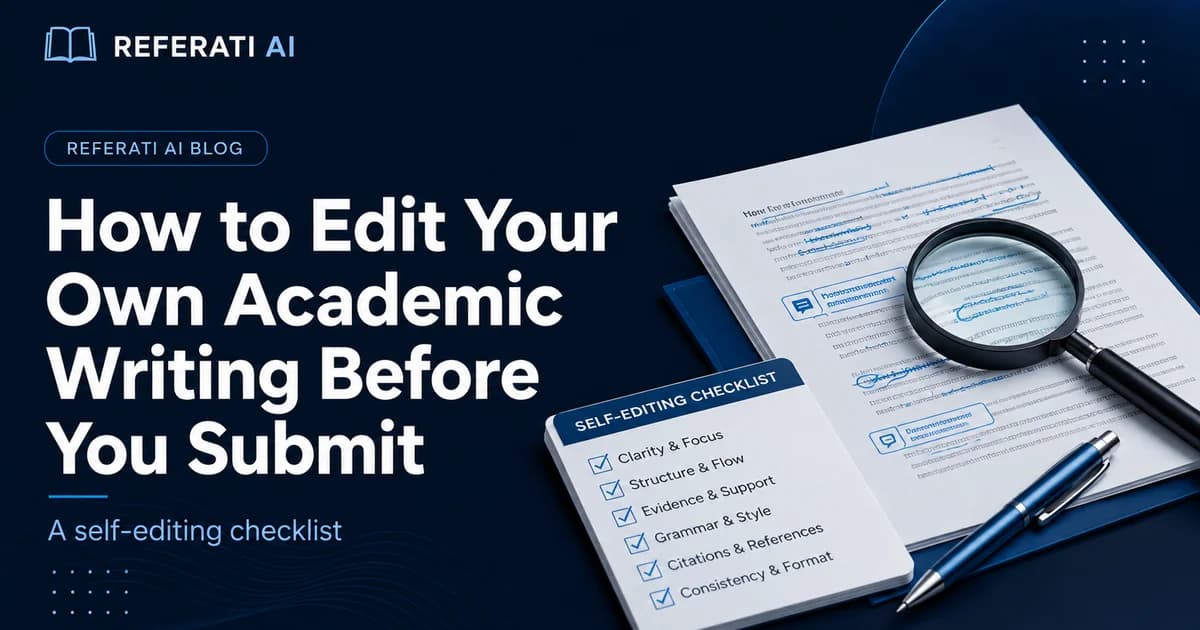
How to edit your own academic writing before you submit
Contents5
To get your research published, learning to edit your own work is a critical skill. With journal rejection rates in some fields reaching over 70%, often due to poor writing, a polished paper stands out. Good editing is about clarity and impact—like turning a bloated 47-word sentence into a tight 24-word one without losing meaning. The key is to separate editing (improving structure and flow) from proofreading (fixing typos) and to create distance from your own text by taking a break and reading it aloud.
Why Is Academic Editing So Important for Getting Published?
Proper editing is about making sure your research is understood, respected, and taken seriously by reviewers and readers. It’s more than just looking professional. In fields where studies influence public policy or medical practice, clear and accurate language isn't just a preference; it’s a core responsibility. A paper with sloppy mistakes can make a reviewer doubt the quality of the research itself.
The best academic publications go through several rounds of editing. This process ensures your argument is logical, your language is concise, and you meet the specific standards of your target journal. Think of it this way: your research might represent a major advance, but if the writing is dense, confusing, or full of errors, your message will get lost. Reviewers are busy people. They are not likely to spend extra time trying to figure out a poorly written manuscript.
A single misplaced comma can change the meaning of a sentence. For instance, "a solvent that dissolves copper" defines one specific type of solvent. But "a solvent, which dissolves copper" just adds an extra detail about a solvent you've already identified. In technical writing, this small difference matters.
Good editing isn't just about avoiding rejection; it's about making an impact. A clear, well-organized paper is more likely to be read, understood, and cited by other researchers, which builds your reputation as a careful and credible scholar. A published paper is permanent. It gets indexed, archived, and linked to your name forever, so any errors it contains will be there for years.
What's the Difference Between Editing and Proofreading?
Many people use these terms as if they mean the same thing, but they describe two different stages of the writing process. Editing improves the core of your writing—its language, structure, and flow. Proofreading is the final polish, where you hunt for typos, formatting errors, and other surface-level mistakes right before submission.
Editing is a deep, multi-level process. When you edit, you should look at the paper from several angles:
- Language: Are your sentences clear? Is the tone right for an academic audience?
- Structure: Does your argument flow logically from one section to the next?
- Style: Does the paper follow the conventions of your field and the journal?
- Technical: Are all figures, tables, and citations formatted correctly?
- Conceptual: Is your main message consistent and well-supported everywhere?
Proofreading, on the other hand, is not the time to question your logic. A proofreader’s job is to make sure you didn't write "form" when you meant "from."
| Focus of Editing | Focus of Proofreading |
|---|---|
| Improving clarity, flow, and logic | Correcting surface errors (typos, grammar) |
| Strengthening sentence structure and word choice | Checking punctuation and formatting |
| Ensuring overall consistency and coherence | Final check before submission |
| A "big picture" review | A "fine-detail" review |
You should always edit first, then proofread. There’s no point in carefully checking the commas in a paragraph that you might end up deleting or completely rewriting during the editing phase.
How Can I Edit My Own Academic Paper Effectively?
Editing your own work is hard because you are too familiar with it. Your brain knows what you intended to say, so it easily skips over typos, awkward phrases, and logical gaps. The trick is to create distance between you the writer and you the editor.
First, step away from the manuscript. Let it sit for at least a few days, or even a week if you can. When you return to it, you'll see it with fresher eyes. This distance helps you spot mistakes you previously overlooked.
Never try to edit a paper immediately after you finish writing it. You're too close to the text. Your brain will automatically fill in missing words and correct errors in your head, making you blind to what's actually on the page.
Next, change how you experience the text. Don't just read it from start to finish on your screen. Try one of these techniques:
- Read it aloud: This forces you to slow down and helps you catch awkward sentences that your eyes might otherwise skim over.
- Read it backward: Go through your paper sentence by sentence, starting with the last one. This isolates each sentence, helping you judge it on its own without the context of what came before.
- Change the format: Print it out, or change the font and text size. Making the document look unfamiliar can trick your brain into paying closer attention.
Finally, use checklists. Instead of a generic one from online, customize it based on your own common mistakes. If you know you often write run-on sentences or use the passive voice too much, add those to your personal list. This turns editing into a systematic process. Resources for authors, like those from Taylor & Francis Author Services, offer great guides and checklists to get you started.
What Are the Risks of Submitting a Poorly Edited Paper?
Submitting a manuscript with obvious errors sends a clear message to journal editors: you are not careful. This can trigger "reviewer bias," where a reviewer forms a negative opinion based on the sloppy presentation, which then colors their assessment of the research itself. The risks are very real.
The most immediate danger is a "desk reject." This is when a journal editor rejects your paper without even sending it for peer review, and a high number of language errors is a common cause. Editors see these mistakes as a sign that the research itself might be just as careless. With rejection rates at some journals exceeding 70%, you don't want to give them an easy reason to say no.
Think of your paper like a job application. Your research is your qualification, but the writing is your cover letter and resume. If the resume is full of typos, you're unlikely to get an interview, no matter how qualified you are.
Even if your paper makes it past the editor, unaddressed errors can lead to requests for major revisions, publication delays, or even retraction after publication. According to an article from Editage, a published work is a permanent part of your academic record. A paper filled with mistakes can damage your reputation long after it's published. It gets cited, archived, and attached to your name, for better or worse.
Frequently Asked Questions
What are the most effective self-editing strategies?
The best strategies create distance. First, take a break of a few days between writing and editing. Second, read your paper aloud to catch awkward phrasing. Third, read the text backward, sentence by sentence, to isolate errors. Finally, create a personalized checklist of your common mistakes.
What is the difference between editing and proofreading again?
Editing is a deep review of your paper's clarity, structure, and argument, focusing on improving the quality of the writing itself. Proofreading is the final, surface-level check for typos, punctuation errors, and formatting mistakes right before you submit. Always edit first, then proofread.
Why is good editing so necessary for academic papers?
Good editing is necessary because it ensures your research is communicated clearly and professionally. It prevents reviewers from getting distracted by errors and questioning the quality of your work. In fields like medicine, precise language is an ethical requirement, as research can influence real-world decisions.
How does poor editing affect my publication chances?
Poor editing greatly increases your chances of a desk rejection. If your paper passes to reviewers, messy writing can create a negative bias, leading to harsh critiques and requests for major revisions. A published paper with errors becomes a permanent part of your academic record, potentially hurting your credibility.
When should I use a professional editing service?
Self-editing is always the first step. If English isn't your first language, you're submitting to a top-tier journal, or you simply want to maximize your chances, a professional service is a smart investment. They provide an expert, objective eye that you can't replicate on your own work.
Are there AI tools that can help with academic editing?
Yes, AI tools have become quite useful. They can help you check for grammar, style, conciseness, and consistency much faster than a manual review. Many platforms offer specialized checks for academic conventions, making them a powerful assistant in the editing process, though they don't replace human judgment.
What is "mechanical editing," and why does it matter?
Mechanical editing involves checking for consistency in capitalization, punctuation, abbreviations, and number formatting. It also includes making sure that your citations, references, tables, and figures all follow the journal's specific style guide. It’s important because it shows you’ve respected the journal’s standards.
While these manual techniques are powerful, you can also use modern tools to help. For instance, an AI designed for academic writing, like referati.ai, can automatically flag issues with grammar, style, and journal conventions, freeing you up to focus on your core arguments.