Turnitin flagged my thesis as AI but I wrote it myself: what to do
Contents
You got the email. Your carefully written paper was flagged by Turnitin's AI detector, but you wrote every word yourself. What now? Don't panic. AI detectors are imperfect tools that often make mistakes, a problem called a "false positive." A 2023 Stanford study found that detectors incorrectly flagged 61% of essays written by non-native English speakers. The key is to calmly gather your evidence—like drafts and version histories—and have a conversation with your instructor to prove your authorship.
Why did my paper get flagged as AI if I wrote it?
Your paper was likely flagged because its writing style triggered patterns that an AI detector associates with machine-generated text. This is a "false positive" and does not mean you cheated. These tools often misidentify human writing, especially from students for whom English is a second language or who have specific writing styles.
A false positive happens when an algorithm wrongly identifies human work as AI-generated. While Turnitin aims for a false positive rate below 1%, real-world testing shows the errors can be much higher. One investigation by the Washington Post found a false positive rate of 50% on a sample of texts. The problem is often worse for certain groups of writers.
The biggest issue is a proven bias against non-native English speakers. A 2023 study from Stanford's Institute for Human-Centered AI discovered that AI detection tools falsely flagged 61% of essays by non-native speakers as AI-made. Their writing, which might use more predictable sentence structures or vocabulary, can look like the patterns detectors are trained to find. The same can happen with neurodivergent students whose writing patterns might differ from what the tool expects.
Turnitin itself does not make a judgment on academic misconduct. The AI score is just one piece of data for your instructor to consider. The company even advises educators to view scores below 20% with caution, as they don't necessarily indicate AI writing.
It also helps to understand what these detectors are looking for. They analyze "perplexity" and "burstiness"—basically, how predictable and varied your sentence structures and word choices are. Human writing usually has a mix of long, complex sentences and short, punchy ones. AI models, especially earlier versions, often produce text with very even sentence lengths. This uniformity is what the detectors flag. If your natural style is very formal and consistent, you might be more likely to trigger a false positive.
How reliable is Turnitin's AI detector, really?
While Turnitin claims its detector has a false positive rate under 1% in controlled settings, independent tests and university experiences suggest it's far less reliable in the real world. Detectors are in a constant battle with AI writers, and they often make mistakes by either flagging human work or missing AI-generated text.
Tech experts agree that there's no perfect way to detect AI text. As one TechCrunch report noted, "As text-generating AI improves, so do detectors—a perpetual back-and-forth like that between cybercriminals and security researchers... there’s no magic bullet to the AI-generated text problem. There likely never will be." This constant race means that detectors are always playing catch-up.
Because of this unreliability, some major universities have simply turned the feature off. Vanderbilt University, for example, disabled Turnitin's AI detector after calculating that with a 1% false positive rate, about 750 of the 75,000 papers submitted in 2022 could have been wrongly flagged. Johns Hopkins, Yale, and Northwestern are among other institutions that have disabled the tool due to concerns about its potential harm to students.
In August 2023, Vanderbilt University's leadership disabled Turnitin's AI detection tool across the institution. They cited the risk of false accusations and the lack of transparency in how the technology works as primary reasons for their decision.
To make things more confusing, these tools can also miss actual AI-generated content. This is a "false negative." Some studies suggest detectors can fail to spot around 15% of actual AI writing. It’s an imperfect science.
What should I do if Turnitin flagged my work?
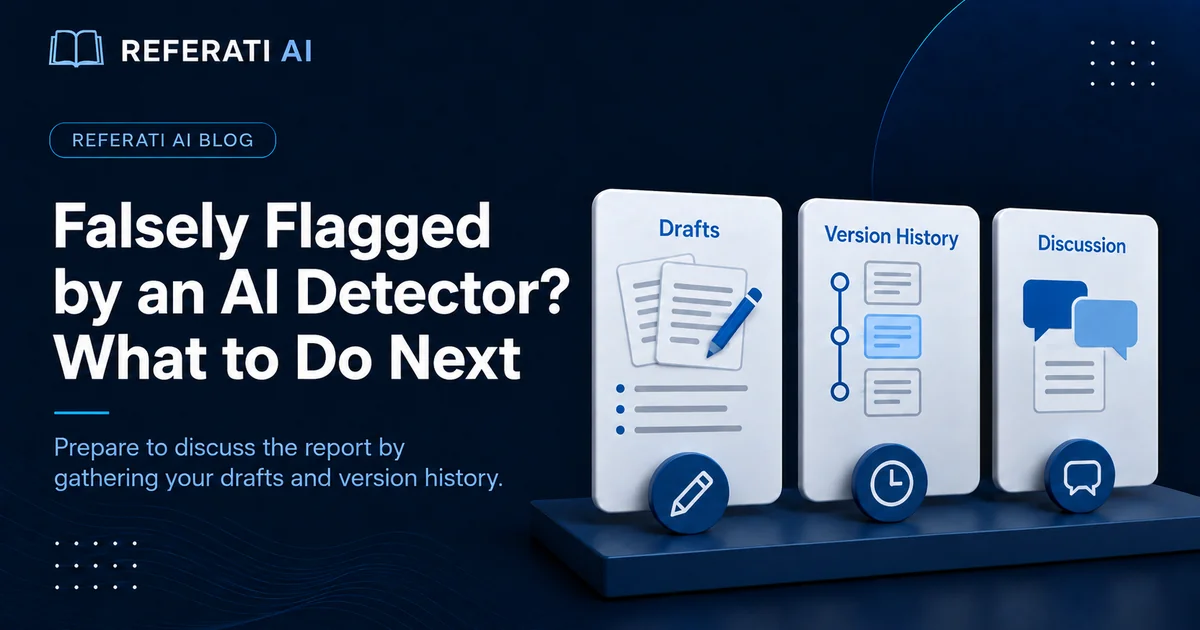
First, don't panic. A high AI score is not a conviction; it's an indicator that prompts a conversation. Your goal is to calmly present the evidence that proves you are the author. The best thing you can do is gather your drafts, notes, and any version history you have.
This proof of your writing process is your best defense.
- Google Docs/Microsoft 365: If you wrote your paper in Google Docs or Word online, your version history is your strongest ally. It shows every edit, every change, and every writing session over time. This is compelling evidence that a human was at the keyboard.
- Outlines and Notes: Did you create a handwritten outline? Do you have research notes, annotated PDFs, or brainstorming documents? Gather them all.
- Source Materials: Collect the articles, books, and web pages you used for your research. Be prepared to discuss how you integrated their ideas in your own words.
- Drafts: Save every version of your paper, from the first rough draft to the final submission. The evolution of the document demonstrates your work.
Before you speak to your professor, organize all your evidence into a single folder. Creating a brief timeline of your writing process shows you're taking the situation seriously and helps you present your case clearly.
Once you have your evidence, schedule a meeting with your instructor. Approach the conversation as a way to clear up a misunderstanding, not as a fight. Explain the situation calmly, state that you wrote the paper yourself, and offer to walk them through your evidence. Showing them your work in progress is often enough to resolve the issue. The Turnitin score is just a data point, not a final verdict.
How can I avoid false AI flags on future papers?
To help prevent false AI detection, focus on varying your writing style and being careful with the tools you use. Actively mix your sentence lengths, avoid generative AI functions in writing assistants like Grammarly, and save evidence of your writing process for every single assignment.
The best defense is a good offense. By adopting certain writing habits, you can make your text appear more "human" to a detector. Vary your sentence structure. Mix long, flowing sentences with short, direct ones. Don't be afraid of using a slightly less formal tone where it's appropriate, as overly formal, predictable prose can sometimes trigger detectors.
Be very careful with writing assistants. Using Grammarly for spelling and grammar checks is fine, but using its generative AI features—like paraphrasing or sentence rewriting—can cause your text to be flagged. Turnitin’s detector may pick up on the patterns these tools create.
| What's Generally Safe | What Carries Risk |
|---|---|
| Using spell check and basic grammar correction. | Using a tool's "rephrase sentence" or "paraphrase" function. |
| Using a citation manager to organize sources. | Asking an AI to generate paragraphs or summaries for you. |
| Brainstorming ideas with an AI chatbot. | Using an AI "humanizer" to disguise AI-written text. |
This last point is tricky. What if your own writing is being falsely flagged? In that specific case, some argue for a defensive strategy. As academic integrity researcher David Kwon explains, "...if Turnitin is mis-flagging your own writing... using a 'humanizer' to normalize the syntactical patterns that are triggering the flags is a defensive strategy, not an act of cheating." This is about making your human writing read as human to a flawed machine, not about passing off machine writing as your own.
Ultimately, documenting your work is the surest way to protect yourself. Keep your notes, save your drafts, and use platforms with a clear version history. If an accusation comes up, that evidence is your best defense.
Frequently Asked Questions
What is a "false positive" in an AI detector?
A false positive is when an AI detector incorrectly flags text written entirely by a human as being AI-generated. This can happen because the person's writing style—perhaps due to its formality or simple sentence structure—mimics patterns the detector is trained to identify as machine-like.
Why is my writing flagged as AI if I wrote it myself?
Your own writing might be flagged if it has low "burstiness" (varied sentence lengths) and "perplexity" (unpredictable word choices). This is a known issue, especially for non-native English speakers, whose writing patterns can sometimes resemble those of AI models, leading to false accusations.
How can I avoid a false positive in Turnitin?
To avoid false positives, vary your sentence length and structure. Avoid using generative AI functions in tools like Grammarly, such as the paraphrasing feature. Most importantly, save all your drafts, notes, and research materials to create a paper trail that proves your authorship if you are questioned.
Does Turnitin account for non-native English speakers?
No, and this is a major criticism. A 2023 Stanford study showed that AI detectors incorrectly flagged 61% of essays from non-native English writers. Their more structured or predictable prose is often misidentified as AI-generated, creating a significant bias in the system.
Should I use Grammarly or other AI writing assistants?
Using tools like Grammarly for basic spell-checking and grammar correction is generally safe. However, using their generative features to rephrase or rewrite sentences can cause your text to be flagged by AI detectors. You should use these advanced features with extreme caution, if at all.
How do I defend myself if Turnitin falsely flags my paper?
Stay calm and gather your evidence. Collect all your drafts, outlines, research notes, and especially the version history from your word processor (like Google Docs). Schedule a meeting with your instructor and respectfully present your evidence to demonstrate your writing process from start to finish.
Why have some universities disabled Turnitin's AI detector?
Several universities, including Vanderbilt, Yale, and Johns Hopkins, have disabled the tool due to concerns about its reliability and the high risk of false positives. They argue that the potential for wrongful accusations and the stress it causes students outweigh the tool's benefits.
If you're looking for a writing partner that understands the demands of academic work without putting you at risk, try referati.ai. It's an AI built from the ground up to support authentic academic writing.