Is translating a foreign source plagiarism?
Contents5
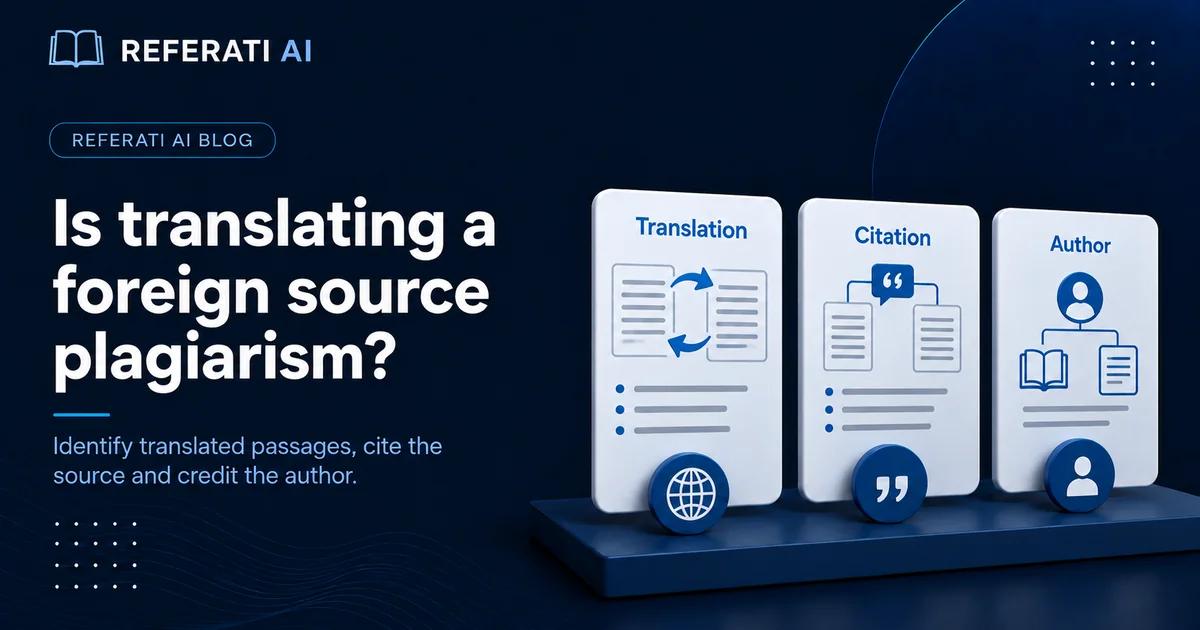
Yes, translating a foreign source without proper citation is considered plagiarism. When you translate text, you're changing the words, but the original ideas and structure still belong to the author. Presenting this work as your own is a form of academic dishonesty called translingual plagiarism. Modern plagiarism tools can detect these unattributed translations by comparing ideas across languages. This is a critical issue, especially since a 2018 study found that only 0.06% of U.S. university integrity policies are available in translation, creating a confusing environment for international students.
What is plagiarism and how does translation fit in?
Plagiarism is using someone else's work or ideas without credit, and this rule absolutely includes translations. Changing the language of a text doesn't make the idea yours. This specific type of academic dishonesty is often called "translingual plagiarism." The core ideas, research, and sentence structure still belong to the original author, so you must cite them properly.
The underlying principle is attribution. The term "plagiarism" has been around for centuries, with the Oxford English Dictionary tracing it back to at least 1621, defining it as a form of literary theft. It's a common mistake to think that because you did the work of translating, the content is now yours. It isn't. The intellectual labor of the original creator must be acknowledged.
You can absolutely quote or paraphrase translated material in your work. The key is to make it clear where the original idea came from. Academic integrity requires you to acknowledge the sources of your information, no matter what language they were originally written in.
Imagine you're writing a dissertation and you find a key research paper in German. You translate a few paragraphs into English and include them in your work. If you don't add a citation pointing to the German paper and its author, you have committed plagiarism, even if you did the translation yourself.
What are the legal aspects of translations and copyright?
Beyond academic rules, there are legal ones. A translation is legally considered a "derivative work," meaning it’s a new creation based on a pre-existing one. According to copyright law, only the copyright holder of the original work has the right to authorize the creation of derivative works, and that includes translations.
If you translate a book, an article, or a website without permission from the copyright owner, you could be infringing on their copyright. This is a separate issue from plagiarism but just as serious. Plagiarism is about academic ethics and giving credit. Copyright infringement is a legal matter that can have financial consequences. For a work to be protected by copyright, it generally needs to show a spark of creativity, and translations are seen as creative works derived from an existing one.
In many countries, the laws are quite clear. For instance, Canadian law states that copyright automatically applies to "every original literary, dramatic, musical and artistic work," which includes translations. This highlights the value and creativity involved in the act of translation. As Nobel laureate José Saramago once said, "Writers make national literature, while translators make universal literature." But this protection is layered and depends heavily on the status of the original work.
| Aspect | Original Author's Rights | Translator's Rights |
|---|---|---|
| Primary Copyright | Holds copyright to the original work. | Does not own the original copyright. |
| Authorization | Must grant permission for a translation. | Must have permission for copyrighted works. |
| Derivative Work | Owns the exclusive right to authorize derivative works. | Their translation is a derivative work. |
| Copyright on Translation | Often owns the translation's copyright as part of the agreement. | May own the copyright only if the original is public domain or specified in a contract. |
Can modern technology detect translated plagiarism?
Yes, modern plagiarism detectors can often spot translated plagiarism. Unlike older tools that were easy to fool, today's software uses cross-lingual analysis. This means it doesn't just match identical words; it can identify the core concepts in an English paper and find them in a source written in French, Spanish, or another language.
These advanced tools make it much harder to hide an unattributed translation. Software from companies like Compilatio can now perform these cross-lingual checks, comparing a text's conceptual footprint against a huge database of documents in other languages. They aren't looking for word-for-word matches. They are looking for matching ideas.
This technology arrives alongside a big challenge in academia. A 2018 study of 453 U.S. universities revealed their academic integrity policies were extremely hard for non-native English speakers to understand. The policies averaged over 2,000 words and were written at a post-graduate reading level, yet only 0.06% of them were available in any language other than English. This gap can lead to students breaking rules they don't fully comprehend.
Using tools like Google Translate or other AI translators to write your paper can be considered plagiarism. If you write an essay in your native language and use a program to translate it, the final wording is not your own—it's the program's. Many universities view this as a violation of academic integrity.
What rights does a translator have?
A translator’s rights generally fall into two categories: moral rights and copyright. Moral rights protect a translator’s reputation and their right to be credited for the work. Copyright, on the other hand, is about the legal ownership of the translated text, which often depends on contracts and the status of the original piece.
Moral rights are about protecting the translator's reputation and the integrity of their work. In many places, a translator has the moral right to be identified as the translator (the right of attribution) and to prevent the translation from being distorted or used in a way that harms their professional reputation. These rights typically belong to the translator even if they don't own the copyright, unless they have formally waived them in writing.
Copyright ownership is more complex.
- If a work is in the public domain (like the plays of Shakespeare), a translator can create a new translation and will typically own the copyright to that specific translation.
- If a work is under copyright, the translator must get permission. In this case, the copyright for the translation might be owned by the original author, the publisher, or the translator, all depending on the contract they signed.
- If the translator is an employee or a freelancer on a work-for-hire basis, the copyright usually belongs to the employer or client, not the translator.
If you're a freelance translator, always get a written agreement that clearly states who will own the copyright to your translation. Don't assume you will own it just because you did the work. A clear contract protects both you and the original author.
Frequently Asked Questions
Is it plagiarism to translate someone's work if I don't cite the source?
Yes, absolutely. Translating content and presenting it as your own without crediting the original author is called translingual plagiarism. The core ideas are not yours, so you must cite the original source, just as you would for a source written in the same language.
Can plagiarism detection software identify translated content?
Yes, modern plagiarism checkers are increasingly able to detect translated content. They use cross-lingual analysis to compare the concepts and structure of a text against a vast database of documents in other languages, making it very risky to pass off a translation as original work.
Do I need the original author's permission to translate their work?
For works protected by copyright, you do. A translation is considered a "derivative work," and the right to create such works belongs to the copyright holder. Translating and distributing a copyrighted piece without permission can be a copyright infringement, which has legal consequences.
Does a translator own the copyright to their translation?
It depends. If the original work is in the public domain, the translator generally owns the copyright to their specific translation. For copyrighted works, ownership is determined by the contract between the translator, author, and publisher. Often, the publisher or original author retains the copyright.
What is "translingual plagiarism" and how do I avoid it?
Translingual plagiarism is the act of passing off a translated text as one's own original work. To avoid it, simply cite your sources. If you quote, paraphrase, or use ideas from a work in another language, provide a full citation to the original author and publication.
How do universities view using Google Translate for assignments?
Most academic institutions consider it a form of plagiarism or academic misconduct if a student uses a tool like Google Translate to write their paper. The final wording is generated by an algorithm, not the student's own intellectual effort, which violates the principles of academic integrity.
What are "moral rights" in the context of translation?
Moral rights ensure that a translator is credited for their work (right of attribution) and can prevent their translation from being altered or used in a way that harms their professional reputation. In many places, these rights belong to the translator even if they don't own the copyright.
For students and writers navigating these complex rules, tools designed for academic work can be a huge help. Try referati.ai: an AI built for academic writing.