Do AI detectors work on non-native English writing?
Contents
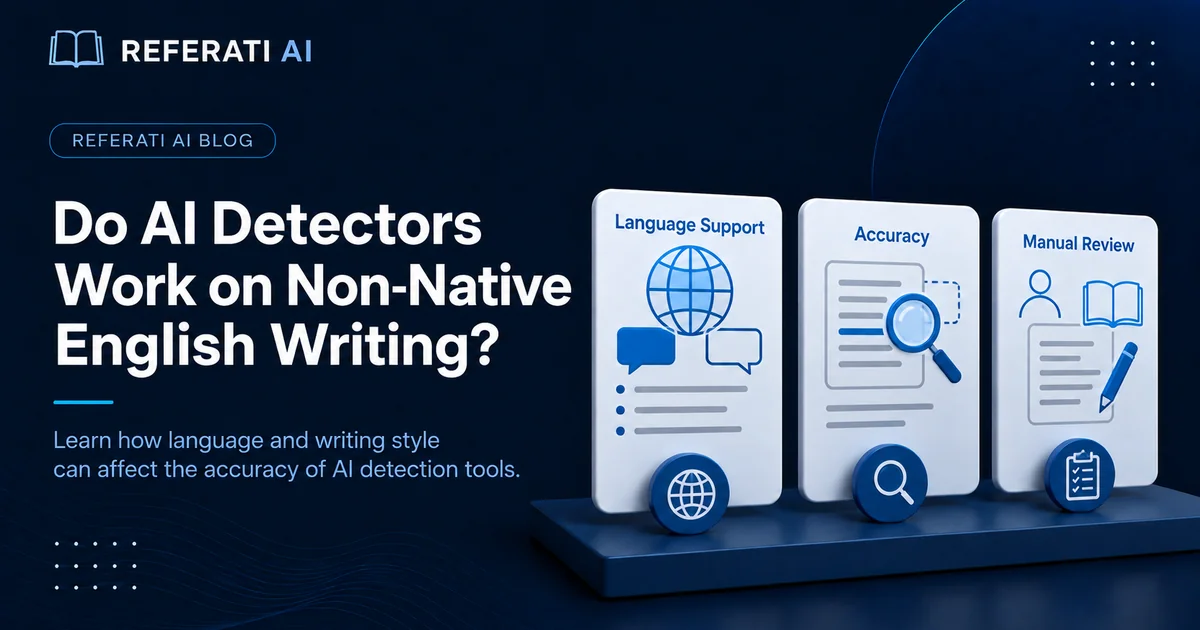
The short answer is not very well, and the results can be deeply unfair. A major Stanford study found that seven popular AI detectors falsely flagged 61.22% of TOEFL essays written by non-native English speakers as being AI-generated. Out of 91 of these human-written essays, a staggering 97% were flagged by at least one detector. The problem is how these tools measure writing complexity. Because non-native writers often use simpler sentence structures and more predictable vocabulary, their writing statistically resembles AI output, leading to a high rate of false accusations.
Why do AI detectors get it so wrong with non-native writing?
AI detectors are not particularly reliable when judging content from non-native English writers, largely because of a built-in bias in how they work. These tools often rely on a metric called "perplexity," which measures how predictable a text is. Writing that's less complex gets a low perplexity score, which the detector often interprets as a sign of AI.
The problem is that this method unfairly penalizes writers who are still developing their English skills. Research from Stanford University shows that non-native writers naturally tend to score lower on metrics like lexical richness and syntactic complexity. Their writing often features:
- Shorter sentences
- Simpler or more predictable grammar
- Fewer idiomatic expressions
- A more direct structure
These are all hallmarks of clear communication. But to an AI detector trained on complex, native-English text, they look suspiciously robotic. As Stanford professor James Zou, a senior author of the study, explains, "[Detectors] tend to rate based on a 'perplexity' metric that correlates to writing sophistication—something non-native speakers naturally lag on when compared with their American counterparts." The detectors are looking for patterns they associate with native English, and when they don't find them, they raise a red flag.
In the Stanford study, AI detectors correctly assessed essays by American 8th graders with "near-perfect" accuracy. But when those same detectors analyzed TOEFL essays from non-native speakers, they classified over half of them (61.22%) as being written by AI. This shows a clear and significant bias.
What are the risks of a false AI detection?
When an AI detector incorrectly flags a student's work, the consequences can be serious. A recent Stanford study revealed just how high the stakes are. While testing seven different AI detectors, researchers found that 18 out of 91 TOEFL essays (19%) were unanimously flagged as AI-generated by all of the detectors. The paper's authors say these numbers "raise serious questions about the fairness of AI detectors."
For non-native English speakers, a false accusation of academic dishonesty can have devastating effects on their careers and education. They may face penalties, fail a course, or even be expelled from their institution based on the output of a flawed tool. This creates an environment of anxiety where students are punished not for cheating, but for their writing style.
Even perfectly honest, human-written work can be flagged if it's "too clean." Damon Delcoro of UltraWeb Marketing notes that he has "seen great human writers get flagged just because they were trying too hard to be 'professional.'" Using overly simple sentence structures or a perfectly balanced format can make your writing look robotic to a detector.
Experts urge caution. The potential for unfairly penalizing honest individuals is simply too great. "The detectors are just too unreliable for now, and the stakes for students are too high, to be relying on these technologies without rigorous evaluation and significant refinement," says James Zou.
Do "hacks" like re-translation or AI humanizers actually work?
No, they usually make things much worse. In an attempt to evade detection, some writers try re-translating their text through multiple languages or using free online "AI humanizer" tools. These methods are based on a misunderstanding of how detectors work and often increase the AI score.
Re-translating a text strips it of natural idioms and variation. The process tends to smooth out the language, making sentence structures and word choices more uniform and predictable. That is exactly the kind of low-perplexity text that AI detectors are designed to flag.
Similarly, most free "AI humanizer" tools are counterproductive. They often rewrite text using a dry, generic academic style, making the grammar "too perfect" and the sentence length too consistent. This erases the author's personal voice and replaces it with a new, equally robotic one.
| Evasion Tactic | Why It Fails |
|---|---|
| Multiple Translations | Strips out natural language and idioms, resulting in overly simple, predictable text that detectors flag. |
| Free "AI Humanizers" | Rewrites text into a generic, formulaic style with uniform sentence length, which increases the AI detection score. |
| Basic Paraphrasers | Often preserves the same predictable structure of the original AI text, which tools like Turnitin and GPTZero can still identify. |
An experiment by JustDone.com showed this clearly. A human-written report that was put through a free "humanizer" was subsequently flagged as 100% AI-generated by leading detectors. Another text, passed through multiple translations, was flagged as 99% AI. These "tricks" don't add human nuance. They just add a different kind of predictable, machine-like pattern.
What should non-native writers understand about these tools?
The most important thing to know is that AI detectors are not judging your intent; they are statistical pattern-matchers. These tools have been trained on vast databases of human and AI-generated text and work by identifying stylistic patterns, sentence structures, and word choices. They don't understand context or authorship.
Because AI detectors are just matching patterns, they can easily get things wrong. If your personal writing style is uncommon or doesn't match the data their models were trained on, you could get a false positive. This is especially true for non-native speakers, whose writing patterns differ from the native-English baseline these tools expect.
Therefore, the score from a detector should never be treated as definitive proof. Some completely human-written essays might show a small AI percentage, while a heavily edited AI draft could score low. The focus should be on institutional policies and teaching students how to use AI tools ethically, not on a witch-hunt driven by unreliable software.
If you are a non-native English writer, protect yourself from false accusations. Keep all your drafts and use a program with version history (like Google Docs) to show your writing process. This provides concrete evidence that you are the author of your work.
Frequently Asked Questions
What's the main reason AI detectors are biased against non-native English writing?
The main reason is their reliance on "perplexity," a metric that measures writing complexity. Non-native speakers often use simpler, more predictable language, which these detectors are trained to associate with AI-generated text. This creates a systemic bias against their natural writing style.
How do AI detectors decide if a text is AI-generated?
AI detectors analyze statistical patterns in writing. They look at factors like sentence length variety (burstiness), word choice, and grammatical structure. By comparing these patterns to huge datasets of known human and AI texts, they calculate the probability that the writing was machine-generated.
What common features of non-native writing get flagged as AI?
AI detectors often flag shorter sentences, simpler vocabulary, and predictable grammatical structures. A lack of complex idioms and a straightforward, formulaic structure can also trigger a false positive because it appears less "human" to the algorithm.
Why doesn't translating a text through multiple languages help avoid detection?
This process tends to make the text more detectable. Each translation smooths out the language, removes natural idioms, and creates a uniform, predictable text. This low-complexity output is exactly what AI detectors are built to identify as machine-generated, often resulting in a very high AI score.
Can I rely on free online "AI humanizers" to make my writing sound human?
No, these tools are generally not reliable and can make your text more likely to be flagged as AI. They often rewrite content into a generic, robotic style with overly perfect grammar and uniform sentence length, stripping away any personal voice and creating new patterns that detectors can easily spot.
What should I do if my work is wrongly flagged as AI-generated?
First, don't panic. Calmly explain the situation to your instructor or manager. Provide evidence of your writing process, such as your notes, outlines, and previous drafts. Using a program with version history (like Google Docs) can be powerful proof that you authored the work yourself.
Are there reliable ways for non-native writers to avoid false positives?
Focus on developing your personal voice. Try to vary your sentence lengths and structures. Don't rely on rigid templates. Most importantly, keep records of your writing process. Showing your drafts and edits is the most reliable way to prove your work is your own.
If you're a student or researcher, using AI correctly means finding tools that help you organize, cite, and brainstorm—not just generate text. A tool like referati.ai is built for this kind of academic partnership, helping you work smarter without the risk of false detection.