Can you reuse your own coursework in your thesis?
Contents5
Reusing your own previous work without permission and proper citation is called "self-plagiarism," and universities treat it as academic misconduct. The main issue is that each assignment, especially a thesis, is expected to be an original piece of work. Submitting old text is seen as trying to get credit twice for a single effort. While you can build on your old ideas, you can't just copy and paste large sections of text. The only way to ethically reuse your work is to get your instructor's direct permission and then cite your previous paper correctly.
What is self-plagiarism, and why is it a problem?
Self-plagiarism, or text recycling, means reusing your own past work in a new assignment without permission or citation. It's a problem because each assignment is expected to be an original effort. According to the University of Missouri's academic integrity office, this misrepresents old work as new, which is a form of academic dishonesty.
The most common misunderstanding is thinking, "It's my work, so how can it be plagiarism?" This misses the point. The issue isn't theft of ideas, but rather a misrepresentation of effort. You're presenting old work as if it were new, which gives you an unfair advantage over students who are creating new work from scratch.
Think of it this way: if a baker sells you a "freshly baked" loaf of bread that was actually baked yesterday, you'd feel deceived, even if that same baker made both loaves. It’s about transparency and fulfilling expectations. In academia, the expectation for a new assignment is a new intellectual effort. Submitting old work breaks that trust.
Many universities don't distinguish between intentional and unintentional self-plagiarism. Whether you meant to deceive your instructor or simply didn't know the rules, the act itself is often considered a violation of academic honesty.
Where's the line between ethical recycling and self-plagiarism?
The line between ethical reuse and self-plagiarism is transparency. Building on your own past ideas is fine, but copying text to get credit a second time is not. If you deceive the reader into thinking old work is new, you have committed self-plagiarism, even if you wrote the original words yourself.
According to the APA manual, the guiding principle is that "the core of the new document must constitute an original contribution to knowledge." You should only include the "minimum amount of previously published material necessary," mainly when discussing theory or methods. The key is to build upon your past work, not just repeat it. This means using your old research as a starting point for deeper analysis, new data collection, or a more sophisticated argument in your thesis.
To do this ethically, you must get permission from your instructor and clearly cite your previous work. Anything less is deceptive.
| Ethical Reuse (with permission) | Unethical Self-Plagiarism |
|---|---|
| Citing your previous unpublished paper as a source. | Copying and pasting sections without quotation marks or citation. |
| Building on previous research with new analysis or data. | Submitting the same paper for two different classes. |
| Summarizing a finding from a past essay in your thesis, with a full citation. | Presenting a chapter from your Master's thesis as original work in your PhD dissertation. |
What are the consequences of self-plagiarism?
The consequences for self-plagiarism are serious, ranging from a zero on an assignment to course failure or even suspension. As guidelines from the University of Copenhagen point out, assessors must be able to distinguish the new work done for the current degree from past research. Self-plagiarism makes this impossible.
For researchers publishing their work, the stakes are even higher. Submitting the same study to multiple journals is a serious ethical breach. One expert, writing for Turnitin's blog, noted this is "widely considered to be unethical and likely constitutes copyright infringement." This can lead to article retractions, which permanently damage a researcher's reputation and credibility in their field.
There is also the problem of "salami-slicing," where a researcher carves up a single study into the smallest possible units to inflate their publication count. This is also considered unethical because it fragments knowledge and makes it harder for other researchers to see the big picture. Ultimately, self-plagiarism undermines the trust that the entire academic system is built on.
How can you reuse your own work the right way?
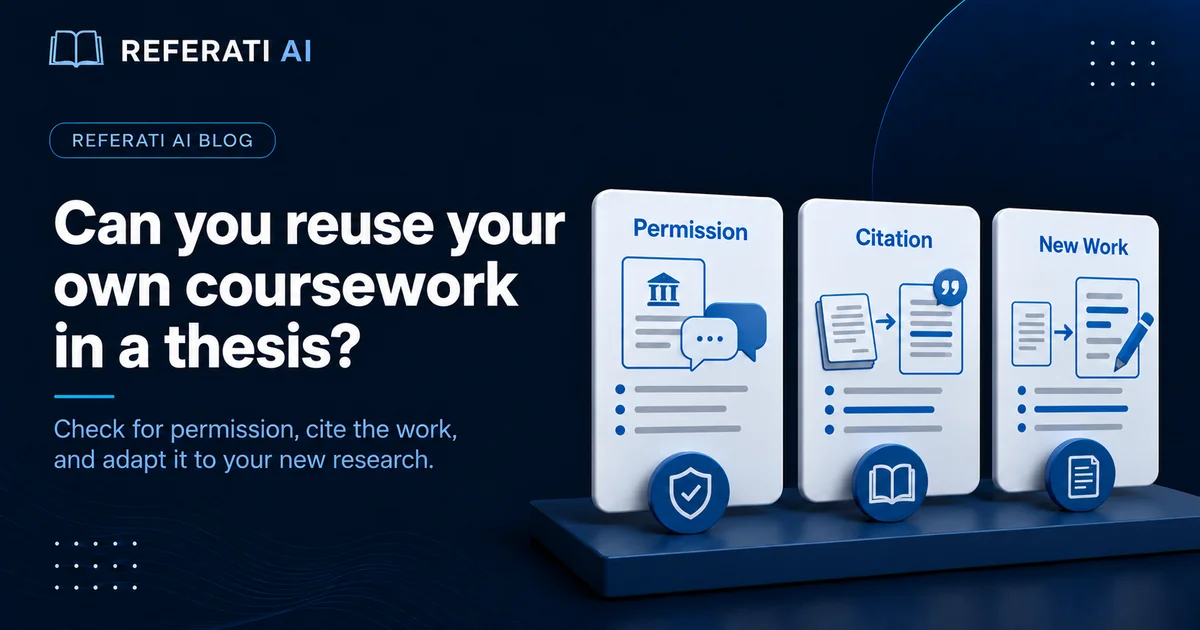
To reuse your own work correctly, you must first get explicit permission from your instructor or thesis advisor. If they approve, you then need to cite your own work properly, usually as an "unpublished manuscript," ensuring the new project adds significant original analysis or research to what you've already done.
This conversation with your advisor is the most important step. Explain what you've written before and how you'd like to build on it. They can give you specific guidance based on your department's and university's policies. They might say no, or they might give you a clear path forward. Never assume it's okay.
If you get approval, you need to cite yourself. Treat your previous coursework as you would any other source.
Let's say you're writing a PhD dissertation and want to include some background from your Master's thesis. You cannot just copy and paste the text. Instead, you should rewrite and summarize the key findings, and then cite your Master's thesis clearly. You might write something like: "Previous research established a baseline for this phenomenon (Author, 2022)." The full citation in your bibliography would then point to your unpublished Master's thesis.
Finally, remember that the goal is to create a new contribution. Your thesis can't just be a collection of previous essays stitched together. You need to add significant new research, analysis, or synthesis. Use your old work as a foundation, not as the building itself.
When you cite your own unpublished work, you are the author. For an APA-style reference, you might list it as: Your Last Name, F. M. (Year). Title of the paper [Unpublished manuscript]. Department Name, University Name.
Frequently Asked Questions
What is self-plagiarism and how does it differ from regular plagiarism?
Regular plagiarism is using someone else's work without credit. Self-plagiarism is reusing your own past work for a new assignment without permission or citation. The key issue with self-plagiarism isn't theft, but rather the misrepresentation of old work as a new and original effort.
When is reusing my own work acceptable?
Reusing your own work is acceptable only with your instructor's explicit permission. Ethically, you can build on your previous ideas, but the new assignment must represent a significant step forward. You must always cite your previous work, making it clear what is old and what is new.
How can I avoid self-plagiarism in my thesis?
The best way to avoid self-plagiarism is to start every assignment from scratch. If you want to use ideas from a past paper, talk to your instructor first. If they approve, treat your old paper like any other source: quote it, paraphrase it, and cite it properly.
Do I really need to ask my instructor for permission?
Yes, always. This is the single most important rule. Assuming it's okay to reuse your work is a huge risk that can lead to academic misconduct charges. Your instructor is the only person who can give you the green light and guide you on how to do it correctly.
How do I cite my own unpublished work, like an old essay?
You should cite your own unpublished work as an "unpublished manuscript" or "unpublished paper" according to your required style guide (APA, MLA, etc.). Generally, this includes your name as the author, the year, the title of the paper, and a note indicating its unpublished status.
Can I use material from a Master's thesis in my PhD dissertation?
Generally, no—not directly. You cannot simply copy-paste text and present it as new doctoral work, as you would be getting credit twice for the same effort. You can, however, summarize and cite your Master's findings as part of your literature review or background section, with your advisor's permission.
If you're working on a major project like a thesis, managing your sources and citations is a huge part of the process. For help keeping everything organized and formatted correctly, try referati.ai: an AI built for academic writing.