How to write a literature review that actually holds together
Contents5
A great literature review isn't just a list of summaries. It’s a story and an argument, weaving together different voices from the research to show the reader the bigger picture. The key is synthesis—a skill that seems to be surprisingly rare. A study of 940 "State-of-the-Art" reviews found that 98% didn't even explain their methodology. True interpretive synthesis is even scarcer; in a 20-year survey of medical journals, only 5 genuine SotA reviews were found out of 963 synthesis articles. So how do you get from a pile of papers to a coherent narrative? Let's break it down.
What's the difference between synthesizing and just summarizing sources?
Synthesizing means building your own argument by combining ideas from multiple sources into a new structure organized by theme. Summarizing, on the other hand, just restates the main points of a single source, usually keeping its original organization. It’s the difference between combining ingredients and just listing them.
Think of it like this: summarizing is like telling a friend what happened in a movie, scene by scene. Synthesizing is like explaining the movie's themes by pulling examples from different scenes and even comparing it to other movies. Academic writing requires synthesis because it proves you've engaged with the material on a deeper level. You understand, you can analyze, and you can create an original perspective from the existing conversation.
There are generally two kinds of synthesis:
- Explanatory Synthesis: Here, you bring sources together to help your reader understand a topic. You're not arguing for one side, but presenting the different views on an issue clearly.
- Argumentative Synthesis: This is where you use your sources to build your own argument. You take a stance and use the evidence from the literature to support your point.
Most literature reviews use a bit of both but lean toward an argumentative synthesis. You are often arguing for the existence of a research gap that your own study will fill.
| Feature | Summarizing | Synthesizing | | :--- | :--- | | Goal | To restate the main points of ONE source. | To combine ideas from MULTIPLE sources to create a new whole. | | Structure | Follows the original source's structure. | Creates a NEW structure organized by theme or argument. | | Focus | What does this one author say? | How do different authors' ideas relate? What new point can I make? | | Outcome | A condensed version of a single text. | An integrated discussion that shows the bigger picture. |
How can I create a coherent story out of all my sources?
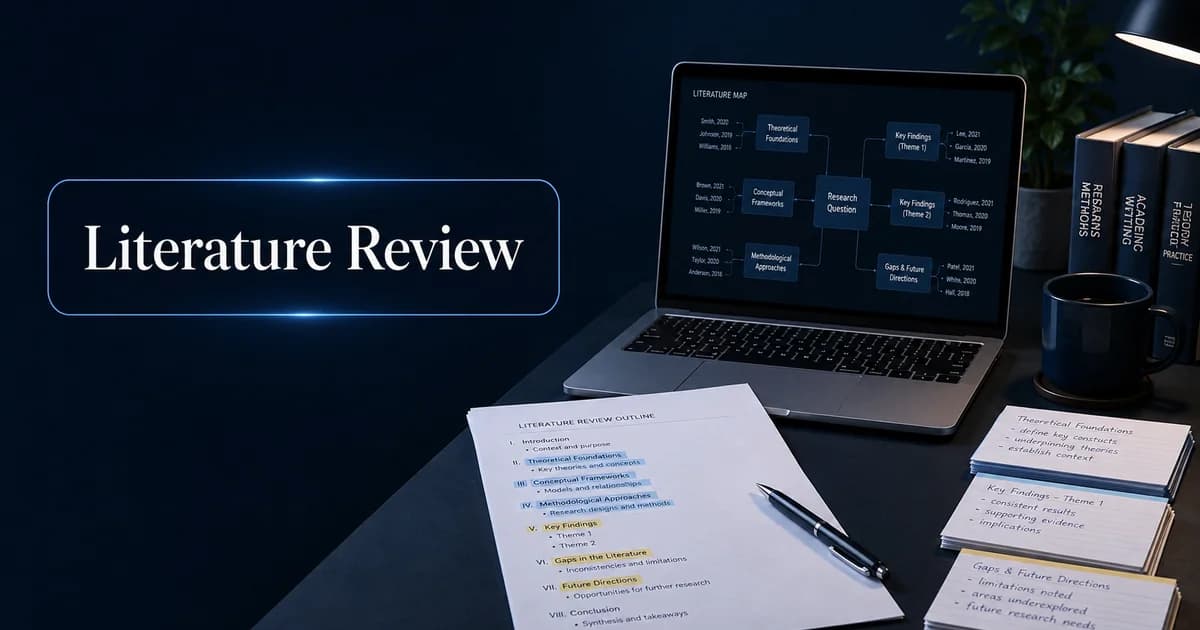
You build a coherent story by organizing your sources around central ideas, not just by author. Group your papers thematically, chronologically, or by methodology. This approach shows how different studies relate to one another and contribute to a larger conversation in your field. This is the key.
The first step is to move beyond seeing each paper as an island. You need to group them. The most common way is thematic. You identify the major topics and debates in the literature and then organize your paragraphs around those themes, discussing how different authors approach each one. For topics with a long history, a chronological approach can work well, showing how the understanding of a topic has evolved over time.
A practical tool to help you do this is a synthesis matrix. It's a simple table where the rows are your sources and the columns are your themes. In each cell, you note what that source says about that theme. This gives you a bird's-eye view, making it easy to spot patterns and connections.
By using a matrix and focusing on themes, you stop writing an annotated bibliography and start writing a true literature review: a piece of analysis that tells the story of the research so far.
What is a "State-of-the-Art" (SotA) review, and why are they so confusing?
A "State-of-the-Art" (SotA) review is meant to provide an interpretive synthesis of a field's progress. The problem is, most are unclear about how they do this. A study in the Journal of Clinical Epidemiology found that 98% of 940 articles calling themselves SotA reviews provided no clear methodology.
This lack of a clear recipe makes it hard for researchers to write one and for readers to trust the conclusions. The term "state of the art" was often used in vague and inconsistent ways. Because of this confusion, truly rigorous SotA reviews are quite rare. The same research group noted that in a search of over 960 knowledge synthesis articles in top medical education journals from 1999-2019, only five could be clearly identified as SotA reviews. These reviews are most common in fast-moving fields like biomedicine and engineering. They chart the past, present, and potential future of a research area.
A weak paper might just list what different authors say. A strong paper, as shown in examples from the University of Oregon's teaching guides, combines multiple sources to build an original point about a central idea. This is the goal of synthesis.
What are the common mistakes to avoid when writing a literature review?
The most common mistake is writing an "annotated bibliography" in paragraph form, where you just summarize papers one after another without connecting them. Another major pitfall is "cherry-picking"—only including studies that confirm your hypothesis while ignoring those that offer conflicting results. This weakens your argument.
Writing a good literature review is a challenge. It's easy to fall into the trap of simply reporting what others have said. Your job, however, is not to be a court reporter but a judge. You need to critically evaluate the sources, not just summarize them. A review that doesn't assess the strengths and weaknesses of the studies it includes is a superficial one. It fails to show the reader why one argument is stronger than another or where the real gaps in the research lie.
Avoid confirmation bias. An effective literature review must honestly engage with conflicting findings. Ignoring studies that challenge your perspective weakens your argument and undermines your credibility as a researcher. Your goal is to represent the conversation as it is, not as you wish it were.
To avoid these errors, always focus on synthesis. For instance, when discussing how to encourage healthy eating in children, you wouldn't just summarize one paper. You'd bring multiple sources into conversation. You could connect the idea that parents should model positive attitudes toward food with research showing small rewards can work, and then weave in findings about the importance of simply having healthy food available. This combination creates a much richer, more useful picture than any single source could alone.
Frequently Asked Questions
How do I tell synthesis apart from summary?
Synthesis combines ideas from multiple sources to create a new structure or argument that is your own. You organize by theme. A summary, in contrast, simply restates the main points of a single source, usually in the same order, without adding new connections or interpretations.
What are some ways to organize my literature review?
The best way is often thematic. Identify the main topics or debates in your field and dedicate sections to each one. You can also use a chronological structure to show how ideas have evolved or a methodological structure to compare studies that used different approaches.
What's a synthesis matrix, and how does it help?
A synthesis matrix is a chart you can make to organize your research. You list your sources down one side and your key themes across the top. Filling it in helps you visually map out which authors discuss which themes, making it much easier to spot patterns and connections.
What's the biggest mistake people make in literature reviews?
The most common mistake is creating a "list of summaries." This is where the writer just describes one paper after another ("Smith found X, then Jones found Y...") without explaining how they relate. A good review weaves these sources together into a single, flowing conversation.
What does "State-of-the-Art" mean in a review?
A "State-of-the-Art" review aims to describe the current high point of knowledge in a particular field. It typically covers the most recent and significant research, explains the historical context of how the field got to this point, and often points toward future research directions.
How do I make sure my review isn't outdated?
Focus your search on papers published in the last 3-5 years, but don't ignore older, foundational studies. Use multiple academic databases to search for keywords. Once you find key papers, look at who they cite and who has cited them to find related work.
What's the very first step in writing a literature review?
Start with a clear question. Before you read anything, know what you're trying to answer. A well-defined research question acts as your guide, helping you decide which sources are relevant and which you can set aside. This focus saves you from drowning in irrelevant papers.
If you're looking for a tool to help organize your sources and streamline this whole process, you might want to try referati.ai: an AI built for academic writing.