How to write an abstract people actually read
Contents5
Your paper’s abstract is often the only part people read, so it has to be good. Most journals require about 200–250 words, but that small space carries a lot of weight. To make it count, focus on clarity and impact by summarizing your three most important findings. Structure it using the IMRaD format (Introduction, Methods, Results, Conclusion), write it after you’ve finished your paper, and always include about five keywords to help others find your work online.
Why is an abstract the gateway to your research?
Think of your abstract as your paper's movie trailer. It’s the only part that appears in conference proceedings and the only thing a potential peer reviewer sees when asked to look at your manuscript. A good abstract convinces them to say yes, while a weak one can get your paper rejected before it's even fully read.
Your abstract is your primary tool for getting noticed. It determines whether a busy researcher, a potential collaborator, or a conference organizer will bother to read your full paper. For many, the abstract is the paper. They'll read it, possibly cite your work based on the summary, and move on. Because of this, your abstract needs to stand on its own as a complete, concise explanation of your work.
It also has a huge effect on discoverability. When your paper is added to online databases like PubMed, Scopus, or Google Scholar, the abstract is indexed along with the title and keywords. A well-written abstract using the right language makes it much more likely that other researchers will find your work. As researcher Lennart Nacke puts it, a great abstract isn't just a summary. It's "a goddamn velvet rope." It controls who gets in.
How long should an abstract be and how should I structure it?
Most journals will ask you to keep your abstract between 200 and 250 words. The exact length, however, depends on the type. A short, descriptive abstract might be only 100-120 words, while a more detailed, informative abstract can be 250 words or more. Always check the journal's specific guidelines.
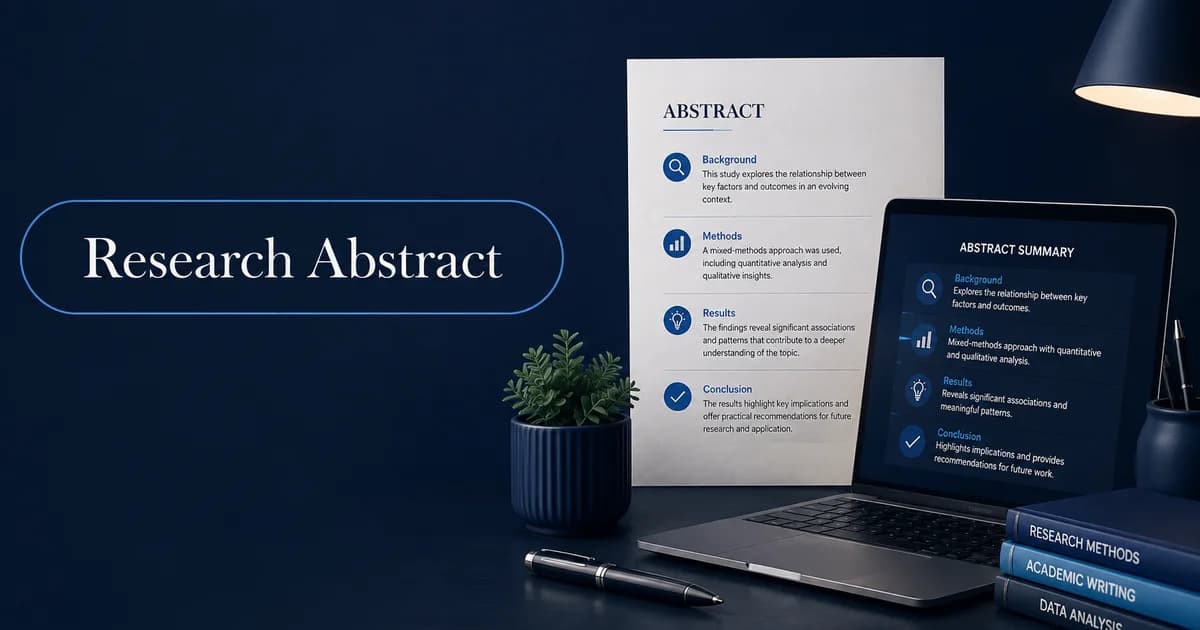
The structure is fairly standard across disciplines, usually following the IMRaD format: Introduction (or Background), Methods, Results, and Conclusion.
- Background: Keep this part extremely short. One or two sentences are often enough to set the stage. You don't need to give a full literature review, just the context for your research question.
- Methods: This is typically the second-longest section. Briefly explain what you did, but don't get bogged down in tiny details. Mention the study design, key techniques, and the main variables you measured.
- Results: This is the most important part of your abstract. State your key findings directly and clearly. Use specific data or statistics where possible.
- Conclusion: What do your results mean? End with a single sentence that summarizes the main takeaway or implication of your work.
| Descriptive Abstract | Informative Abstract |
|---|---|
| Purpose: Describes the paper's content without giving results. | Purpose: Summarizes the entire paper, including results and conclusions. |
| Length: 100-120 words. | Length: 250+ words, a mini-version of the paper. |
| Content: Mentions the topic, scope, and methods. | Content: Includes background, methods, key results, and conclusion. |
| Use Case: More common in humanities and social sciences. | Use Case: Standard for scientific papers and STEM fields. |
What common mistakes should I avoid when writing an abstract?
The biggest mistake is treating the abstract as an afterthought you rush at the last minute. Another common error is simply copying and pasting sentences from your introduction and conclusion. This creates a clunky text that doesn't flow like a proper summary and fails to provide a clear, unified message.
Your abstract needs to be written from scratch, in its own words. It should be a self-contained piece that makes perfect sense to someone who hasn't read the paper. Avoid using undefined acronyms or jargon that would require the reader to look inside the main text for clarification. The goal is to make their life easier.
Do not copy and paste sentences directly from your paper to build your abstract. An abstract is a unique summary, not a collection of quotes from your own work. It needs to be rewritten for conciseness and flow.
Another problem is information overload. You can't fit your entire paper into 250 words, so don't try. A good rule of thumb is to limit yourself to highlighting your three most important findings. This forces you to focus on what truly matters and prevents you from overwhelming the reader with secondary details.
How can I write an abstract that grabs a reader's attention?
To write an abstract that gets noticed, you need to think strategically. Don't just report "what we did." Instead, focus on "why it matters." You want to create a short narrative that hooks the reader from the first sentence by presenting a problem or a gap in knowledge that your research addresses.
For instance, instead of starting with "This paper investigates X," try opening with the problem itself. This immediately tells the reader why your work is important.
Instead of a long background sentence like: "The efficacy of the antidepressant desvenlafaxine (DV), a dual-action drug, has been established...", you can be much more direct. The fact that it's a known drug is assumed. Just state the problem you are investigating to save precious word count for your results.
This approach makes your research feel relevant and urgent. It answers the reader’s unspoken question: "Why should I care about this?" Once you've hooked them, present your methods and results as the solution or the new insight that fills that gap.
A great opening hooks the reader by highlighting a problem. For example: "Rising rates of burnout among surgical residents have intensified the need for evidence-based interventions. However, few studies have evaluated..."
Finally, make your work discoverable. Researchers recommend including at least five keywords at the end of your abstract. These aren't just an afterthought. They are the search terms that will lead others to your paper in online databases. A clear, direct, and easily discoverable abstract sets a positive tone for the entire peer-review process and increases the chances your work will be read and cited.
Frequently Asked Questions
What is the main purpose of an abstract?
An abstract's main purpose is to provide a concise, standalone summary of your entire paper. It helps readers quickly understand your research's topic, methods, key findings, and conclusions, allowing them to decide whether to read the full text. It's also used for indexing in academic databases.
What should be the length of an abstract?
Most academic journals require abstracts to be between 200 and 250 words. However, this can vary. Descriptive abstracts are shorter, around 100-120 words, while some informative abstracts can be longer. Always check the specific guidelines of the journal or conference you are submitting to.
What main sections should an abstract contain?
A standard abstract includes four main parts that mirror the paper's structure: Background (a brief introduction to the problem), Methods (what you did), Results (your key findings), and Conclusion (the main takeaway or implication of your work).
When is the best time to write an abstract?
The best time to write your abstract is after you've finished writing the entire paper. This allows you to have a clear and complete understanding of all sections, from the introduction to the conclusion, ensuring your summary is accurate and thorough.
Why is it important to include keywords?
Including keywords is critical for discoverability. When your paper is published online, these keywords act as search tags in academic databases like Google Scholar or PubMed. They help other researchers find your work when they search for papers on related topics.
What should we avoid when writing an abstract?
Avoid copying and pasting sentences from your main paper. Also, don't use undefined acronyms, excessive jargon, or references to figures or tables in the main text. Keep background information to a minimum and focus on your results. Don't try to include every finding; stick to the main ones.
How can I make my abstract more appealing to readers?
Start with a strong hook that highlights a problem or a gap in knowledge your research addresses. Focus on explaining why your work is important, not just what you did. Use clear, direct language and active voice. End with a strong concluding sentence that states the main significance of your findings.
Getting an abstract right can be tough. If you want help refining your structure and phrasing, an AI tool designed for academic writing, like referati.ai, can offer suggestions and help you polish your final draft.