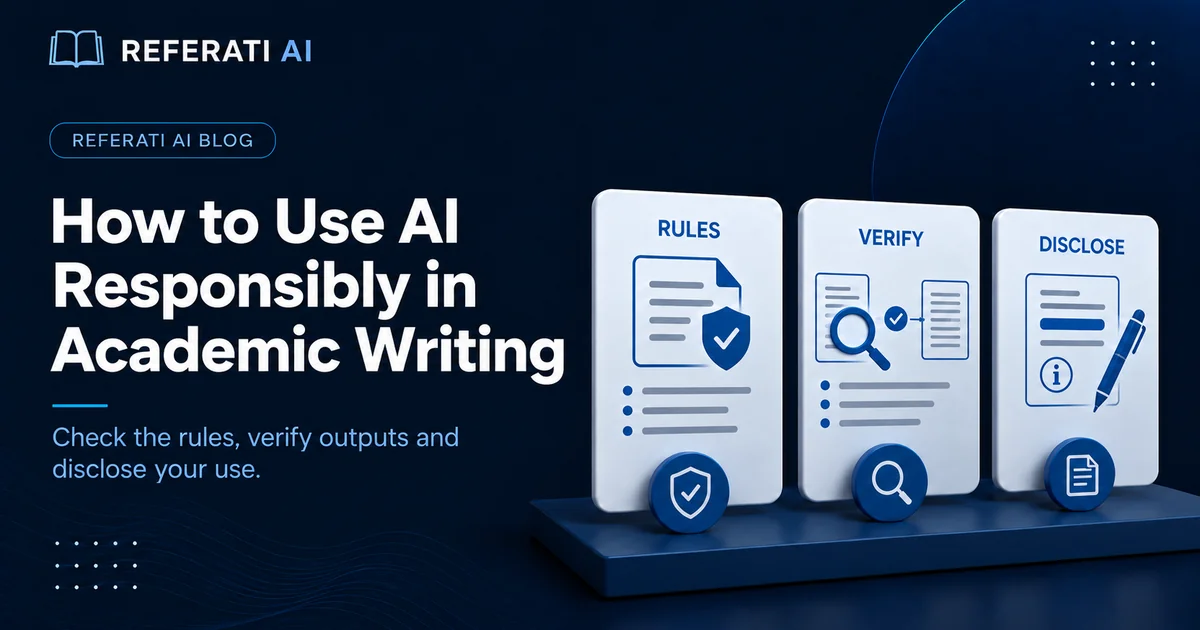
How to use AI responsibly in academic writing
Contents
Using AI in your academic work is possible, but the rules are strict. Never submit unedited AI text as your own; that's academic misconduct. The goal is to use AI as a research assistant, not as the author. For ethical use, you must disclose how you used AI tools and cite them correctly, following guidelines like the APA's format, which was updated on April 7, 2023. Be wary of AI detection software, as many universities discourage its use due to high rates of false positives.
How can AI improve the academic writing process?
AI tools can help at almost any stage of writing, from brainstorming topics and creating outlines to summarizing dense research papers. An AI is great for getting past a blank page or organizing your thoughts, but it should never replace your own critical thinking and analysis.
Think of an AI as a very capable research assistant, not the author. At the start of a project, you can use tools like Elicit or Semantic Scholar to find relevant papers or map out connections between different ideas. This can be a huge time-saver. According to guidance from the University of Kansas, AI can be used for inspiration, structuring, formatting, research, and feedback. You might ask an AI to summarize a dense academic article to quickly decide if it's relevant to your argument. This helps you work smarter.
A sociology student struggling to find a dissertation topic on urban migration could ask an AI to generate related sub-themes. The AI might suggest exploring the impact of climate change or socioeconomic factors on migration in Europe. The student then uses these ideas as a starting point for their own focused research.
You must remain in control. The AI might provide raw material or a rough outline, but you do the intellectual heavy lifting: the analysis, the synthesis of ideas, and the final writing. It’s a support tool. One study on the topic notes that AI should "assist, but not replace, human judgment in academic work." Your brain is the most important tool you have.
How do I maintain academic integrity when using AI?
Maintaining academic integrity with AI hinges on transparency. Submitting raw, unedited AI text as your work is misconduct. To use AI ethically, you must be honest about which tools you used and for what purpose, and give proper credit through citations or disclosure notes.
Academic integrity is about being honest in your work so others can trust that you did what you claim you did. As Megan McNamara at UC Santa Cruz puts it, "Integrity... is one of the most valuable assets you can develop in life." When you use AI, you need to be transparent. Many institutions, like Walden University, explicitly state that students are expected to disclose their use of AI. This might mean adding a paragraph in your methodology section or a note to your instructor explaining which tool you used and for what purpose (e.g., brainstorming, grammar checks). If you use AI-generated text, you must cite it.
| Responsible AI Use | Academic Misconduct |
|---|---|
| Brainstorming topics & refining research questions | Submitting an entire AI-written essay as your own |
| Summarizing sources to decide if they're relevant | Copying AI-generated text without proper citation |
| Checking grammar and improving sentence structure | Asking AI to perform the core analysis or argument |
| Disclosing AI use in a methodology section | Hiding the use of AI tools against course policy |
Your work should still be your work. It must reflect your learning and critical thinking. Hiding your use of AI or letting it do the core thinking for you defeats the purpose of your education and is a serious ethical breach.
What are the rules for using AI at universities?
University rules on AI vary dramatically. There is no single standard; policies differ between schools and even between courses. Your professor’s rules are what matter most. Always check the course syllabus for a specific AI policy and ask your instructor directly if you have any questions.
Because the technology is so new, universities are still figuring out their official stances. Some have embraced generative AI, while others have placed heavy restrictions on it. A survey of global university policies shows a wide range of approaches. These rules are also likely to change often as the technology develops. What's acceptable this semester might not be next semester. Don't assume.
Your instructor's policy is the one that matters most. Some may ban AI entirely, viewing original writing as a key learning outcome. As Professor Lis Horowitz of Salem State University states in her syllabus, "AI-generated submissions are not permitted and will be considered plagiarism." Others may allow it for specific tasks, like creating an outline. Always check.
The best approach is to be proactive. Read your course syllabus carefully for any mention of an AI policy. If there isn't one, or if it's unclear, ask your instructor directly for clarification. This protects you from accidentally committing academic misconduct and shows you're taking your academic integrity seriously.
What are the risks of using AI in academic writing?
The biggest risk of using AI is factual inaccuracy. AI models often "hallucinate," inventing facts, statistics, and fake sources with great confidence. As the author, you are responsible for everything in your paper, which means you must verify every single claim the AI generates.
As Professor Ethan Mollick of Penn’s Wharton School warns students, "Don't trust anything it says... You will be responsible for any errors or omissions the tool provides." If an AI gives you a statistic, assume it's wrong until you can verify it with a reliable source. AI models can also reflect the biases present in their vast training data. A recent article in AI and Ethics highlights that these technologies can "unintentionally perpetuate and amplify existing biases," which can lead to skewed and unfair research findings. This is a serious ethical concern.
Think of AI output as a first draft written by an intern who is brilliant but sometimes makes things up. Your job as the researcher is to verify every single claim before you even consider including it in your work.
Another common misconception involves AI detection. In reality, AI detection tools are often inaccurate. They have a high rate of "false positives," meaning they might flag human-written text as being AI-generated. Because of this unreliability, many universities actively discourage instructors from using these detectors as a basis for academic misconduct cases.
How do I cite AI-generated content?
You should cite AI-generated content just like any other source. Major style guides now have specific rules for this. For example, the APA published its official AI citation guidelines on April 7, 2023. Following these formats allows you to be transparent and give proper credit.
The general principle is to treat the AI company as the author and include details about the specific version of the model you used. This is because the models are constantly being updated, and a prompt can produce different results on different dates. For example, the official APA citation format looks like this:
OpenAI. (2023). ChatGPT (May 24 version) [Large language model]. https://chat.openai.com/chat
This approach aligns with the transparency required by institutions like Walden University, which expects students to clearly document when and how AI was used. Always check which citation style your course requires (APA, MLA, Chicago, etc.) and look up the most current guidance for citing generative AI in that format.
Frequently Asked Questions
What counts as academic misconduct when using AI?
Submitting unedited AI-generated text as your own original work is the most common form of misconduct. This also includes using AI for tasks your instructor has forbidden, hiding your use of AI, or letting an AI perform the core analysis for your assignment. Always check your course policy.
Do I have to disclose that I used AI in my work?
Yes, in most cases. Transparency is essential for academic integrity. Many universities require you to disclose when and how you used AI, either in a note to your instructor or in a methodology section of your paper. If you quote AI-generated text directly, you must cite it.
How can AI be used ethically in the learning process?
Use AI as a tool to support, not replace, your own thinking. Ethical uses include brainstorming ideas, creating an initial outline, summarizing dense research articles, or checking your grammar and style. The goal is to enhance your learning, not to shortcut the intellectual work.
How do I cite AI-generated content?
Most style guides, like APA and MLA, now have specific formats. Generally, you credit the company that created the model (e.g., OpenAI) as the author, list the model name (e.g., ChatGPT), and include the version and date you used it, as the output can change over time.
Do AI use rules differ between universities or courses?
Yes, dramatically. There is no universal standard. Policies range from complete prohibition to open encouragement. Your specific course syllabus is the most important guide, and your instructor has the final word on what's acceptable for their assignments. When in doubt, always ask.
Can AI do my critical analysis for me?
No. This crosses a clear ethical line. The core purpose of most academic assignments is to develop and demonstrate your own critical thinking skills. Outsourcing this work to an AI defeats the purpose of your education and is almost always considered academic misconduct.
How can I check the accuracy of AI-provided information?
Treat every factual claim from an AI with skepticism. You must manually verify any data, statistics, dates, or quotes by cross-referencing them with reliable sources like academic journals, reputable news outlets, or official reports. Assume it's wrong until you prove it's right.
Navigating these new rules takes care and practice. As you get started, you might find that tools designed specifically for academic work, like referati.ai, can help you integrate AI assistance responsibly and ethically from the beginning.